US Taxation: A Quick Guide for Beginners!

09 – List of 1040 Form Varients with Due Dates

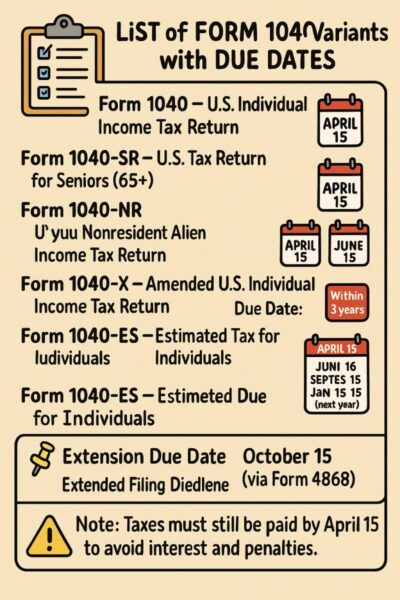
📅 Due Dates for Filing IRS Form 1040 Individual Tax Returns:- 1.   Form 1040 – U.S. Individual Income Tax Return 🗓️ Due Date: April 15 📌 Used by most U.S. taxpayers to report income, deductions, and credits. 2.   Form 1040-SR – U.S. Tax Return for Seniors (Age 65+) 🗓️ Due Date: April 15 📌 Similar to Form 1040 but with a larger font and simplified layout for seniors. 3.   Form 1040-NR – U.S. Non-resident Alien Income Tax Return 🗓️ Due Date: o  April 15 – if wages subject to U.S. withholding o  June 15 – if no U.S. wage income 📌 Filed by non-resident aliens with U.S. income. 4.   Form 1040-X – Amended U.S. Individual Income Tax Return 🗓️ Due Date: Within 3 years from the original due date (including extensions) 📌 Used to correct previously filed Form 1040, 1040-SR, or 1040-NR. 5.   Form 1040-ES – Estimated Tax for Individuals 🗓️ Due Dates (Quarterly Payments): o  1st Payment: April 15 o  2nd Payment: June 15 o  3rd Payment: September 15 o  4th Payment: January 15 📌 For taxpayers with income not subject to withholding (e.g., self-employed). 📝 Extension Option – File Form 4868 to request an automatic 6-month extension- 📅 New deadline becomes October 15 ⚠️ Important: Taxes must still be paid by April 15 to avoid penalties and interest.  

09 – List of 1040 Form Varients with Due Dates Read More »
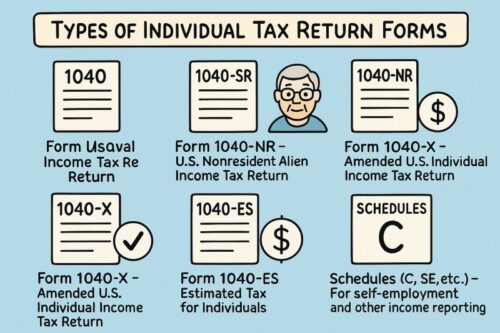
08 – Types of Individual Tax Returns & Forms

✅ Types of Individual Tax Returns & Forms When filing U.S. federal income taxes, individuals generally use Form 1040 series. Here are the main types: 1. Form 1040 – U.S. Individual Income Tax Return Who uses it? Most U.S. taxpayers (residents, citizens, and some non-residents) Purpose: Reports income, claims deductions/credits, calculates tax/refund Includes: Schedules for income (Schedule 1), itemized deductions (Schedule A), business income (Schedule C), etc. 2. Form 1040-SR – U.S. Tax Return for Seniors Who uses it? Taxpayers 65 or older Features: Larger font, simplified layout Same calculations as Form 1040 Includes standard deduction chart on first page 3. Form 1040-NR – U.S. Nonresident Alien Income Tax Return Who uses it? Non-resident aliens with U.S. source income (e.g., foreign students, non-resident investors) Differences: Cannot claim standard deduction (except India treaty exception for students), limited credits 4. Form 1040-X – Amended U.S. Individual Income Tax Return Who uses it? Taxpayers who need to correct a previously filed 1040 When to file: For errors in income, credits, deductions (not for math mistakes IRS corrects automatically) 5. Form 1040-ES – Estimated Tax for Individuals Who uses it? Individuals who expect to owe $1,000 or more in tax after withholding (e.g., freelancers, self-employed) Purpose: Pay quarterly estimated taxes 6. Form 1040 Schedule C / Schedule SE Who uses it? Self-employed individuals Purpose: Report business income (Schedule C) and calculate self-employment tax (Schedule SE) ✅ State Returns: In addition to federal forms, most states require separate individual income tax returns using their own forms.

08 – Types of Individual Tax Returns & Forms Read More »

07c – Standard Deduction vs. Itemized Deduction – Which One Should You Choose?

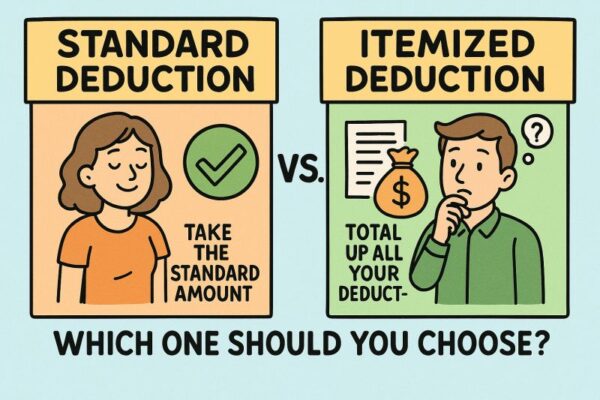
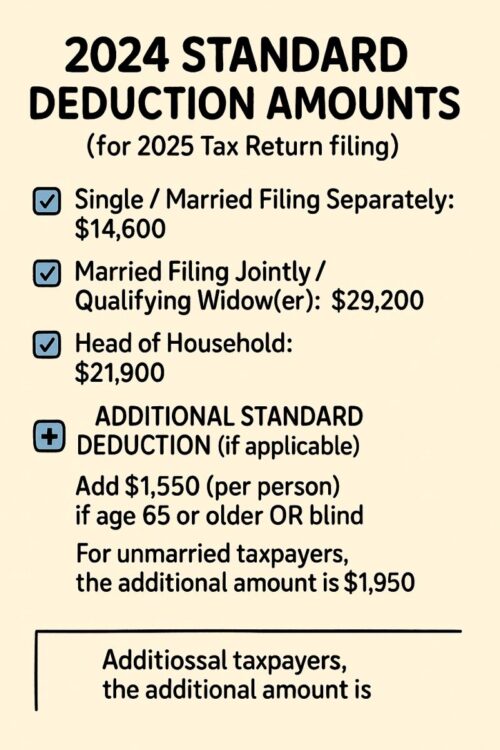
🧾 Standard Deduction vs. Itemized Deduction – Which One Should You Choose? When filing IRS Form 1040, you have two ways to reduce your taxable income: ✅ Standard Deduction ✅ Itemized Deductions (Schedule A) But you can claim only ONE. So, which is better for you? Let’s break it down: 🔹 Standard Deduction Fixed amount based on your filing status No receipts or proof required Quick and simple filing 2024 Standard Deduction (for 2025 filings): Single / Married Filing Separately: $14,600 Married Filing Jointly: $29,200 Head of Household: $21,900 ➕ Additional: $1,550 per person (65+ or blind) 🔹 Itemized Deductions (Schedule A) List actual deductible expenses instead of a flat amount Requires documentation (receipts, bills, Form 1098, donation letters, etc.) Common categories: ✅ Mortgage interest ✅ State & local taxes (SALT) – capped at $10,000 ✅ Charitable contributions ✅ Medical expenses (over 7.5% of AGI) ✅ Casualty losses (disaster areas) 💡 Real-Life Example Case 1: Standard Deduction John is single with no mortgage, few medical bills, and small donations. Standard Deduction = $14,600 Itemized total = $6,000 (rent not deductible) ✅ John should take Standard Deduction Case 2: Itemized Deduction Sarah & Mike are married filing jointly, own a home, pay high property tax, and donate to charity. Mortgage interest = $15,000 SALT taxes = $10,000 (limit) Charitable contributions = $6,000 Total Itemized = $31,000 ✅ Sarah & Mike should itemize, since $31,000 > $29,200 ✔ Rule of Thumb: Take the option that gives you the bigger deduction. For most taxpayers, the Standard Deduction wins.

07c – Standard Deduction vs. Itemized Deduction – Which One Should You Choose? Read More »

07b – Standard Deduction

🧾 Standard Deduction: – ✅ What is the Standard Deduction? A fixed dollar amount that reduces from your taxable income No need to provide receipts or itemize expenses Automatically applied unless you choose to itemize deductions 📌 2025 Standard Deduction Amounts (for Tax Returns filed in April 2026): Single / Married Filing Separately: $15,750 Married Filing Jointly / Qualifying Widow(er): $31,500 Head of Household: $23,625 ➕ Additional Standard Deduction (if applicable): Add $1,600 (per person) if age 65 or older OR blind For unmarried taxpayers, the additional amount is $2,000 🟩 Who Should Take It? Most taxpayers — especially if they don’t have high deductible expenses Ideal for simpler returns with no mortgage, large donations, or major medical expenses 📝 No Documentation Required, but keep records in case your filing status or age-based eligibility is questioned 💡 Tip: Always compare your itemized deductions (Schedule A) against the standard deduction — use whichever is higher to reduce your tax

07b – Standard Deduction Read More »

07a – Form 1040 – Deductions: What Can You Claim & What Documents Do You Need?

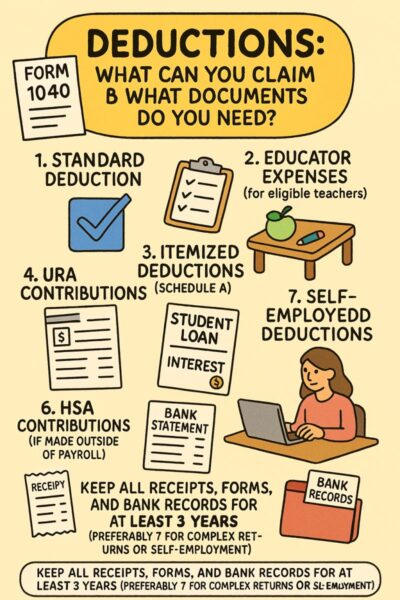
🧾 Form 1040 – Deductions: What Can You Claim & What Documents Do You Need? When filing your U.S. Individual Income Tax Return (Form 1040), you may reduce your taxable income by claiming standard or itemized deductions. If you itemize, make sure to keep proper documentation in case of an IRS review. 🔹 1. Standard Deduction No documents required to claim — it’s a fixed amount based on your filing status (e.g., single, married filing jointly, etc.). 🔹 2. Itemized Deductions (Schedule A) You’ll need proof of payment for each category: 📌 Medical & Dental Expenses Doctor/dental bills, prescriptions Health insurance premiums (if not pre-tax) Mileage logs for medical travel ✅ Document: Receipts, statements, insurance EOBs 📌 State and Local Taxes (SALT) Property tax bills State/local income or sales tax ✅ Document: Tax bills, pay stubs, receipts 📌 Mortgage Interest Interest on home loans ✅ Document: Form 1098 from your lender 📌 Charitable Contributions Donations to qualified charities ✅ Document: Donation receipts, letters of acknowledgment 📌 Casualty and Theft Losses (only in federally declared disaster areas) ✅ Document: Insurance claims, repair estimates, photos 📌 Miscellaneous Deductions (very limited post-TCJA) Gambling losses (up to winnings) ✅ Document: W-2G, logs of gambling activity 🔹 3. Educator Expenses (for eligible teachers) Up to $300 for classroom supplies ✅ Document: Receipts, supply lists 🔹 4. Student Loan Interest Up to $2,500 deduction ✅ Document: Form 1098-E 🔹 5. IRA Contributions (Traditional IRA, not Roth) ✅ Document: Bank/brokerage statements showing contributions 🔹 6. HSA Contributions (if made outside of payroll) ✅ Document: Form 5498-SA 🔹 7. Self-Employed Deductions Home office, business mileage, supplies, health insurance ✅ Document: Invoices, receipts, mileage logs, insurance statements 💡 Pro Tip: Keep all receipts, forms, and bank records for at least 3 years (preferably 7 for complex returns or self-employment).

07a – Form 1040 – Deductions: What Can You Claim & What Documents Do You Need? Read More »

06k – Form 1099-K – Payment Card & Third-Party Network Transactions:-

📘 Form 1099-K – Payment Card & Third-Party Network Transactions:- 🔹 Purpose Reports payments you received through credit/debit cards or third-party payment networks (e.g., PayPal, Venmo, Square, Stripe, Amazon). 🔹 When You Receive It *If you have over $600 in payments (as per IRS rules, effective from 2023 tax year; phased-in in some cases). *Applies to freelancers, gig workers, small business owners, and online sellers. 🔹 Key Information on the Form *Gross amount of payments received *By month (breakdown of total transactions) *Payment network details *Federal/state tax withholding (if any) 📅 Deadlines *Sent to taxpayers: By January 31 *Filed with IRS: By February 28 (paper) / March 31 (e-file) 💡 Example: If you sold handmade crafts on Etsy and received $1,200 via PayPal, you’ll get a Form 1099-K. ✅ Tip: Keep detailed business expense records (supplies, shipping, fees). The IRS taxes net income (profit), not total payments shown on Form 1099-K.

06k – Form 1099-K – Payment Card & Third-Party Network Transactions:- Read More »

06j – Form SSA-1099 – Social Security Benefit Statement:-

📘 Form SSA-1099 – Social Security Benefit Statement:- 🔹 Purpose The SSA-1099 is a tax form issued by the Social Security Administration (SSA). It shows the total Social Security benefits you received in a given tax year. 🔹 Who Gets It? Everyone who received Social Security benefits (retirement, disability, survivor, or other benefits) during the year will receive this form. (Exception: If you only received Supplemental Security Income (SSI), you won’t get an SSA-1099 because SSI is not taxable.) 🔹 Key Information on the Form:- *Total benefits received (before deductions) *Medicare premiums or other deductions taken from your benefits *Net benefits paid to you *Any federal income tax withheld (if you chose voluntary withholding) 🔹 How It’s Used :- *Helps you determine if your Social Security benefits are taxable. *Used when preparing your federal income tax return (Form 1040). *You or your tax preparer use the amounts to calculate the portion of benefits that may be taxable (up to 85%, depending on your total income). 📅 Deadline *Sent to taxpayers: By January 31 *Not filed with IRS by the taxpayer — instead, used to report benefits on Form 1040, Lines 6a & 6b. 💡 Example: If you received $18,000 in Social Security benefits and $3,000 is taxable, Form SSA-1099 helps you calculate and report it. ✅ In short: Form SSA-1099 tells you how much Social Security you received in a year and whether any of it may be taxable.

06j – Form SSA-1099 – Social Security Benefit Statement:- Read More »

06i – Form 1099-B – Proceeds from Broker and Barter Exchange Transactions:-

📘 Form 1099-B – Proceeds from Broker and Barter Exchange Transactions:- 🔹 What It Is IRS form issued by brokers or barter exchanges to report sales and exchanges of capital assets. It helps you calculate capital gains or losses for your tax return. 🔹 When You Receive Form 1099-B 1.   Sale of Stocks, Bonds, or Mutual Funds – Through a brokerage account. 2.   Options or Commodity Transactions – Futures, contracts, etc. 3.   Barter Exchange Transactions – Goods/services traded via an exchange. 4.   Regulated Futures Contracts & Securities Futures – Reportable transactions. 🔹 Key Information on the Form *Date of acquisition & sale *Sales proceeds *Cost basis (if known) *Type of gain/loss (short-term or long-term) *Federal tax withheld (if any) 📅 Deadlines *Sent to taxpayers: By February 15 *Filed with IRS: By February 28 (paper) / March 31 (e-file) 💡 Example 👉 You bought stock for $5,000 and sold for $8,000 in 2024. Your broker will issue a 1099-B in Feb 2025, showing a $3,000 gain, which you must report on Schedule D & Form 8949.

06i – Form 1099-B – Proceeds from Broker and Barter Exchange Transactions:- Read More »

06h – Form 1099-R – Distributions from Pensions, Annuities, Retirement, or Insurance Contracts:-

📘 Form 1099-R – Distributions from Pensions, Annuities, Retirement, or Insurance Contracts:- Form 1099-R is issued when you receive a distribution of $10 or more from retirement-related accounts or contracts. It reports both taxable and non-taxable portions of the distribution. 🔹 When You Receive Form 1099-R 1.   Pension or Annuity Payments – Regular retirement income. 2.   401(k), 403(b), or 457(b) Distributions – Withdrawals from employer retirement plans. 3.   IRA (Traditional, SEP, SIMPLE) Distributions – Withdrawals or rollovers. 4.   Insurance Contracts – Certain life insurance or annuity payouts. 5.   Roth IRA Conversions – Moving funds into a Roth IRA. 6.   Early Distributions (before age 59½) – May include penalties unless exceptions apply. 🔹 Key Information on Form 1099-R *Box 1: Gross distribution (total amount paid). *Box 2a: Taxable amount (what you must report as income). *Box 4: Federal income tax withheld. *Box 7: Distribution code (explains type of withdrawal – normal, early, rollover, etc.). 📅 Deadline Sent to taxpayers: By January 31 Filed with IRS: By February 28 (paper) / March 31 (e-file) 💡 Example 👉 If you withdrew $15,000 from your Traditional IRA in 2024, you’ll receive Form 1099-R in Jan 2025. Unless it was a rollover, most or all of it will be taxable and reported on Form 1040, lines 4a–4b. ✅ Tip: Keep track of rollover vs. taxable withdrawals — rollovers are usually non-taxable but must still be reported.

06h – Form 1099-R – Distributions from Pensions, Annuities, Retirement, or Insurance Contracts:- Read More »

06g – Form 1099-G – Certain Government Payments (Unemployment Benefits):-

📘 Form 1099-G – Certain Government Payments (Unemployment Benefits):- Form 1099-G is issued by federal, state, or local governments to taxpayers who received certain types of government payments during the year. It helps ensure that individuals report these amounts as income when filing their Form 1040 (U.S. Individual Income Tax Return). 🔹 Common Situations Where You Receive Form 1099-G 1.   Unemployment Compensation – If you received unemployment benefits, the total amount is reported on 1099-G (must be included as taxable income). 2.   State or Local Tax Refunds, Credits, or Offsets – Reported if you itemized deductions in the prior year. 3.   Agricultural Payments – Farmers receiving subsidies or grants. 4.   Taxable Grants – Government research grants or other taxable aid. 5.   Reemployment Trade Adjustment Assistance (RTAA) Payments. 🔹 Key Details *Issuer: Government agency (state, federal, or local). *Recipient: Taxpayer who received the payment. *IRS Copy: Sent directly to IRS to match with your return. 📅 Deadline to Receive: By January 31 of the following year. 💡 Example: If you received $8,000 in unemployment benefits in 2024, you’ll get Form 1099-G in early 2025, and must report that income on Form 1040, Schedule 1. ✅ Remember Even though it comes from the government, most payments on Form 1099-G are taxable. Always review it carefully when filing your return.  

06g – Form 1099-G – Certain Government Payments (Unemployment Benefits):- Read More »