November 2025

Early Tax Planning: Get Ahead of the Game

💡 Why You Should Start Thinking About Taxes Now (Not Just in April) Most people only think about taxes when it’s almost time to file — usually around April 15th.But here’s the truth: by then, it’s too late to actually save on taxes. Good tax planning doesn’t start when you’re filing your return — it starts before the year ends.The earlier you plan, the more control you have over how much tax you pay and how much you keep in your pocket. Think of it like this 👇If you wait until the game is over, you can’t change the score.But if you plan during the game, you can still make the winning moves. 🏆 🔹 What Early Tax Planning Can Do for You 1️⃣ Find more deductionsWhen you start early, you have time to spot deductions you might miss later — like business expenses, mileage, charitable donations, or education costs. 2️⃣ Contribute to tax-saving accountsYou can still put money into IRAs, 401(k)s, or HSAs before year-end — lowering your taxable income and building your future savings. 3️⃣ Manage your investments smartlyReview your gains or losses.You can use tax-loss harvesting (selling at a loss to offset gains) — a powerful way to reduce taxes on your investments. 🧠 The Big Idea Tax planning isn’t about finding “loopholes” — it’s about being smart and intentional with your money before the IRS gets their share.Every small step you take now — even just adjusting your withholdings or making an IRA contribution — can save you hundreds or thousands later. Don’t wait for April.Start now. Give yourself the chance to keep more of what you earn — legally, strategically, and stress-free. 💼💰  

Early Tax Planning: Get Ahead of the Game Read More »
Understanding Code G on Form 1099-R — What It Really Means

💡 Understanding Code G on Form 1099-R — What It Really Means As a tax preparer, I often notice clients getting confused about Code G on their Form 1099-R.Many assume that if a dollar amount appears on the form, it automatically means tax is due. “This is income — so I’ll have to pay tax on the whole amount.” Not necessarily! In fact, Code G is usually a good sign.It often indicates a tax-free transaction, if handled correctly. 🏦 Example: A $1 Million 401(k) Rollover Let’s say someone retires with $1,000,000 in their 401(k). They have three choices for moving that money: 1️⃣ Direct Rollover to a Traditional IRA (Tax-Free) If the full $1 million is rolled directly into a Traditional IRA, there’s no tax and no penalty. Box 1 (Gross Distribution): $1,000,000 Box 2a (Taxable Amount): $0 Box 7: Code G – Direct Rollover Because the funds moved from one qualified account to another, it’s not taxable. 2️⃣ Cashing Out (Taxable) If the person takes the money in cash, the entire $1 million becomes taxable as ordinary income.If they’re under age 59½, they’ll also face a 10% early withdrawal penalty.💸 A large portion of their retirement savings could go to taxes and penalties. 3️⃣ Converting to a Roth IRA (Roth Conversion) If the $1 million is rolled into a Roth IRA, it becomes fully taxable that year —but future growth and qualified withdrawals will be 100% tax-free. 🔍 Key Takeaway Form 1099-R reports money movement, not always taxable income.When you see Code G, it often means the funds were rolled over — not withdrawn.Handled correctly, it can mean zero tax owed today and smarter tax-free growth for the future.

Understanding Code G on Form 1099-R — What It Really Means Read More »

Understanding IRAs — Your Retirement Money’s Best Friend

💰 Understanding IRAs — Your Retirement Money’s Best Friend A lot of people hear the term “IRA” and immediately think “some complicated tax thing my accountant handles.”But really, it’s just a special account designed to help you save for retirement — with tax benefits. Let’s break it down simply 👇 🔹 What Is an IRA? IRA = Individual Retirement Account.It’s not an investment itself — it’s a container where your investments (stocks, bonds, funds, etc.) grow with special tax treatment. Think of it as: A retirement “wrapper” that tells the IRS how your money should be taxed (or not taxed). 🧩 The Two Main Types 1️⃣ Traditional IRA You contribute pre-tax dollars (money you haven’t paid tax on yet). Your money grows tax-deferred — meaning no tax each year as it grows. You pay tax when you withdraw in retirement. Good for: People expecting to be in a lower tax bracket when they retire. 🧾 Tax Tip: You may get a tax deduction for contributions (subject to income limits). 2️⃣ Roth IRA You contribute after-tax dollars (money you’ve already paid tax on). Your money grows tax-free. You withdraw it tax-free in retirement (if rules are met). Good for: People expecting to be in a higher tax bracket later or wanting tax-free income in retirement. ✨ Biggest advantage: Tax-free growth forever — no tax when you take it out (after age 59½ and 5 years). ⚖️ Quick Comparison Feature Traditional IRA Roth IRA Contributions Pre-tax (may be deductible) After-tax (no deduction) Growth Tax-deferred Tax-free Withdrawals Taxable Tax-free (qualified) Best for Lower taxes later Higher taxes later Age limit Contribute until 70½ (if working) No age limit (if income eligible) 💡 Bonus: SEP IRA & SIMPLE IRA For business owners or freelancers, these versions allow bigger contributions: SEP IRA: Great for self-employed; higher limits, flexible. SIMPLE IRA: For small businesses; employer and employee contributions allowed. 🚫 Early Withdrawal Rule Taking money out before age 59½ usually triggers a 10% penalty + tax,unless you qualify for exceptions (like first-time home purchase, education expenses, or disability). 📘 Real Talk You don’t have to be rich to open an IRA.Even small, consistent contributions can turn into a significant retirement fund thanks to compound growth and tax advantages. The earlier you start, the more your money works — not the IRS. 💪

Understanding IRAs — Your Retirement Money’s Best Friend Read More »

Why choose an S-Corp over a standard LLC?

A regular LLC is simple to operate — but here’s the catch:➡️ The entire profit is usually subject to Self-Employment (SE) tax. 💼 S-Corporation Highlights ✅ Reduces SE tax burden✅ Files Form 2553 to elect pass-through treatment✅ Avoids double taxation (no corporate-level tax) ⚖️ The Key Difference Salary (W-2): “Reasonable compensation” paid to the owner — subject to payroll/FICA taxes. Distributions (K-1): Remaining profit — not subject to SE tax. 💡 Example A solo consultant earns $150,000 in net profit: Scenario 1 – Standard LLC/Sole Prop→ Entire $150,000 × 15.3% SE tax = $22,950 Scenario 2 – S-Corporation→ Pays themselves $80,000 salary (W-2)→ Takes $70,000 as distribution (K-1)→ FICA on salary = $12,240 💰 S-Corp saves over $10,000 in FICA taxes. ⚠️ Important: Reasonable Compensation If you underpay yourself (say, $10K salary + $140K distribution), the IRS can reclassify part of that distribution as salary — leading to back taxes, interest, and penalties. A “reasonable” salary is what your business would pay an unrelated employee for the same role. ✅ Advantages Significant tax savings on distributions Limited liability protection (same as LLC) ❌ Disadvantages Payroll setup required Quarterly filings (Form 941) Owner must receive W-2 Must file Form 1120-S IRS scrutiny of “reasonable compensation” ❓ Common Question: Q: An S-Corporation can only have certain types of shareholders.What is the maximum number of shareholders an S-Corp is allowed to have? A: The IRS allows up to 100 shareholders — and all must generally be U.S. citizens or resident individuals.(S-Corps cannot have partnerships, corporations, or nonresident aliens as shareholders.) Bottom Line:S-Corp status can be a smart tax move for profitable small businesses —but it comes with extra admin responsibilities and IRS compliance.

Why choose an S-Corp over a standard LLC? Read More »

2025 tax deadlines for non-US LLC owners

  IRS already updated the 2025 tax deadlines for non-US LLC owners. And they aren’t what you think. Most founders are still working off 2024 calendars. That’s a four-figure mistake waiting to happen… Here are the dates that matter RIGHT NOW: → March 17, 2025: Form 1120 (if your LLC elected C-corp status) → April 15, 2025: Form 1040 (if you’re a U.S. tax resident with LLC income) → June 16, 2025: Form 1040-NR (for non-resident aliens) → June 16, 2025: Form 5472 + Pro-forma 1120 (Foreign-owned LLCs must file even with ZERO transactions) → September 15, 2025: Extended deadline (if you filed for extension) Now, here’s what blindsides founders every year: → Your LLC formation date doesn’t determine your tax year → State tax deadlines are different from federal → Form 5472 has a separate deadline (with $25K penalty for late filing) → Extensions don’t extend your payment deadline The most expensive assumption in this scenario is: ‘I’ll just file when my accountant tells me to.’ If your accountant doesn’t specialize in non-US LLC owners, they might not know about many forums, FinCEN BOI requirements, or state-specific nexus rules. And you’re still liable. So here’s what you need to do TODAY: 1. Mark every single deadline in your calendar 2. Set reminders 30 days before each date 3. Confirm which forms YOU specifically need to file 4. Don’t assume your situation matches someone else’s The IRS doesn’t grade on effort. They grade on dates. And the penalties compound daily.

2025 tax deadlines for non-US LLC owners Read More »

US Payroll – Step 10: Reconcile Each Period

1️⃣ Match Records – Reconcile payroll register with tax deposits & general ledger (GL). 👉 Example: Payroll shows $5,000 tax withheld, but bank shows $4,800 → investigate $200 difference. 2️⃣ Fix Discrepancies – Correct missed withholdings, wrong entries, or bank mismatches right away. 3️⃣ Why It Matters – Ensures accuracy, prevents IRS notices, and keeps payroll books clean.

US Payroll – Step 10: Reconcile Each Period Read More »

US Payroll – Step 9: File Periodic Reports

1️⃣ Form 941 (Quarterly) – Report federal income tax withheld + employer/employee FICA to IRS. (Filed every quarter (April, July, October, January)). 👉 Example: If you withhold $500 in taxes and $300 in FICA, report $800 total 2️⃣ Form 940 (Annual) – Report FUTA (Federal Unemployment Tax) to IRS. 👉 Example: For 3 employees earning $7,000 each → FUTA = $7,000 × 6% × 3 = $1,260. 3️⃣ State Filings – Submit state income tax withholding & unemployment (SUTA) returns monthly or quarterly as per state rules. 👉 Example: California employers file SUTA quarterly via EDD online. 4️⃣ New Hire Reporting – Report new employees to your state directory (usually within 20 days). 👉 Example: Hired on Nov 1 → report to state by Nov 20. ✨ Timely filing = smooth compliance & no penalties!

US Payroll – Step 9: File Periodic Reports Read More »

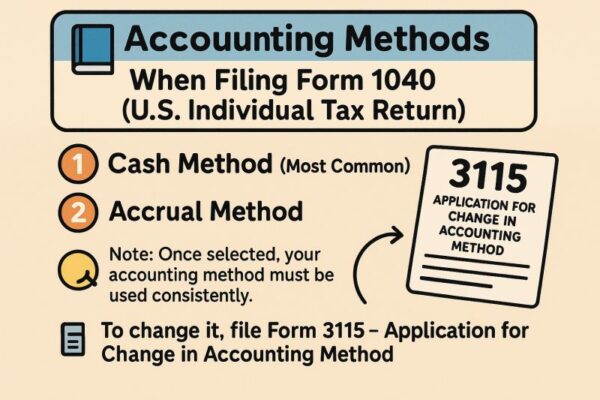
10 – Accounting Methods When Filing Form 1040 (U.S. Individual Tax Return)

📘 Accounting Methods When Filing Form 1040 (U.S. Individual Tax Return) When reporting income and expenses, the IRS allows individuals to use one of the following accounting methods: 1️⃣ Cash Method (Most Common) ✅ Income is reported when received ✅ Expenses are deducted when paid 🧾 Simple and ideal for employees, freelancers & small businesses 2️⃣ Accrual Method 📊 Income is reported when earned (even if not received) 📉 Expenses are deducted when incurred 🔍 Typically used by businesses with inventory or complex operations 3️⃣ Hybrid Method 🔄 A mix of cash & accrual 📦 Common for businesses tracking inventory (e.g., accrual for sales, cash for expenses) 🔄 Note: Once selected, your accounting method must be used consistently. 📄 To change it, file Form 3115 – Application for Change in Accounting Method

10 – Accounting Methods When Filing Form 1040 (U.S. Individual Tax Return) Read More »

US Payroll – Step 8: Run Payroll & Issue Pay Stubs to Employee

    1️⃣ Run Payroll – Calculate total pay and deductions, then process payments via ACH/direct deposit or printed checks. 👉 Example: Employee earns $2,000 gross pay –  taxes & deductions ($400) = $1,600 net pay. 2️⃣ Issue Pay Stubs – Share detailed breakdowns showing: • Gross Pay • Deductions (taxes, benefits, etc.) • Employer Contributions • Net Pay 3️⃣ Why It Matters – Pay stubs ensure transparency and help employees verify their earnings and tax withholdings.

US Payroll – Step 8: Run Payroll & Issue Pay Stubs to Employee Read More »