Payroll

US Payroll – What is Form W-4 – Employee’s Withholding Certificate

πŸ’Ό US Payroll 🧾 What is Form W-4 – Employee’s Withholding Certificate :- πŸ“˜ Form W-4 is filled out by employees so employers know how much federal income tax to withhold from their paycheck. βœ”οΈ 1️⃣ Purpose Tells the employer how much tax to withhold based on the employee’s personal situation. βœ”οΈ 2️⃣ Who Files It Filed only by employees β€” not employers. βœ”οΈ 3️⃣ When It’s Used β€’ At the start of a new job β€’ When personal or financial situations change (marriage, dependents, extra income) βœ”οΈ 4️⃣ What It Includes β€’ Filing status (Single/Married) β€’ Number of dependents β€’ Extra withholding (if any) β€’ Multiple job adjustments πŸ“˜ Simple Example *John starts a new job. *He is married and has 1 child, so he fills out Form W-4 showing his filing status and dependent. *His employer uses this info to withhold the correct tax from each paycheck. πŸ’‘ Quick Tip: Form W-4 = Employee’s tax withholding instructions.

US Payroll – What is Form W-4 – Employee’s Withholding Certificate Read More Β»

US Payroll – Step 12: Year-End Tasks (Easy & Clear)

πŸ’Ό US Payroll – Step 12: Year-End Tasks (Easy & Clear) :- 1️⃣ Prepare & Distribute Form W-2: *Provide W-2s to all employees and file W-2/W-3 with SSA. *Due Date: January 31 (for both employee copies & SSA filing). *Example: If an employee earned $45,000, issue their W-2 by Jan 31st. 2️⃣ Follow Electronic Filing Rules: E-filing is required if total information returns β‰₯ IRS threshold. 3️⃣ Issue Form 1099-NEC to Contractors: *Send 1099-NEC to contractors paid $600+ and file with IRS. *Due Date: January 31 (recipient copy + IRS filing). *Example: If a contractor was paid $1,200, issue the 1099-NEC by Jan 31st. 4️⃣ Accuracy Check: Double-check names, SSNs, EIN, and wages/taxes before filing to avoid corrections.

US Payroll – Step 12: Year-End Tasks (Easy & Clear) Read More Β»

US Payroll – Step 11: Correct Payroll Tax Errors

πŸ’Ό US Payroll – Step 11: Correct Payroll Tax Errors :- 1️⃣ Fix Reporting Errors – Use Form 941-X for payroll tax adjustments and W-2c/1099-c for correcting employee wage/tax details. πŸ‘‰ Example: If Social Security wages were overstated by $200, file Form 941-X to correct it. 2️⃣ Know the Correction Timeline – β€’ Form 941-X: Can generally be filed within 3 years of the original Form 941 filing date. β€’ W-2c: File as soon as an error is identified (no strict deadline but must be corrected promptly). β€’ 1099-c: Should be corrected as soon as possible after discovering an error. 3️⃣ Keep Documentation – Maintain copies of all correction forms and a brief note explaining the reason for the change. 4️⃣ Why It Matters – Timely corrections avoid penalties, avoid IRS notices, and ensure accurate employee records. ✨ Clean corrections = clean compliance!

US Payroll – Step 11: Correct Payroll Tax Errors Read More Β»

US Payroll – What is Form W-3? – Simple Explanation

🧾 What is Form W-3? – Simple Explanation πŸ‘‰ Form W-3 is a summary form that the employer sends to the Social Security Administration (SSA). βœ… 1️⃣ Purpose Summarizes the total wages, taxes withheld, and Social Security/Medicare amounts for all employees. βœ… 2️⃣ Who Files It Filed only by employers β€” not employees. βœ… 3️⃣ What It Includes Totals W-2 forms for the year issued to the Employee (wages, SS wages, Medicare wages, tax withheld). βœ… 4️⃣ When Used Sent to SSA along with all employee W-2s. (One W-3 covers all W-2s for the company.) ➑️ Form W-3 is commonly used while preparing tax returns such as S-Corporation, C-Corporation, and Partnership returns, to verify total wages reported and ensure payroll amounts match the company’s financials. πŸ“˜ Example If a company has 8 employees, it submits: β€’ 8 β€” Β W-2 forms β†’ to employees & SSA β€’ 1 Β β€” W-3 form β†’ summary of all 8 W-2s πŸ’‘ Quick Tip: Form W-3 = Employer’s summary of all W-2s.

US Payroll – What is Form W-3? – Simple Explanation Read More Β»

US Payroll – Step 10: Reconcile Each Period

1️⃣ Match Records – Reconcile payroll register with tax deposits & general ledger (GL). πŸ‘‰ Example: Payroll shows $5,000 tax withheld, but bank shows $4,800 β†’ investigate $200 difference. 2️⃣ Fix Discrepancies – Correct missed withholdings, wrong entries, or bank mismatches right away. 3️⃣ Why It Matters – Ensures accuracy, prevents IRS notices, and keeps payroll books clean.

US Payroll – Step 10: Reconcile Each Period Read More Β»

US Payroll – Step 9: File Periodic Reports

1️⃣ Form 941 (Quarterly) – Report federal income tax withheld + employer/employee FICA to IRS. (Filed every quarter (April, July, October, January)). πŸ‘‰ Example: If you withhold $500 in taxes and $300 in FICA, report $800 total 2️⃣ Form 940 (Annual) – Report FUTA (Federal Unemployment Tax) to IRS. πŸ‘‰ Example: For 3 employees earning $7,000 each β†’ FUTA = $7,000 Γ— 6% Γ— 3 = $1,260. 3️⃣ State Filings – Submit state income tax withholding & unemployment (SUTA) returns monthly or quarterly as per state rules. πŸ‘‰ Example: California employers file SUTA quarterly via EDD online. 4️⃣ New Hire Reporting – Report new employees to your state directory (usually within 20 days). πŸ‘‰ Example: Hired on Nov 1 β†’ report to state by Nov 20. ✨ Timely filing = smooth compliance & no penalties!

US Payroll – Step 9: File Periodic Reports Read More Β»

US Payroll – Step 8: Run Payroll & Issue Pay Stubs to Employee

    1️⃣ Run Payroll – Calculate total pay and deductions, then process payments via ACH/direct deposit or printed checks. πŸ‘‰ Example: Employee earns $2,000 gross pay – Β taxes & deductions ($400) = $1,600 net pay. 2️⃣ Issue Pay Stubs – Share detailed breakdowns showing: β€’ Gross Pay β€’ Deductions (taxes, benefits, etc.) β€’ Employer Contributions β€’ Net Pay 3️⃣ Why It Matters – Pay stubs ensure transparency and help employees verify their earnings and tax withholdings.

US Payroll – Step 8: Run Payroll & Issue Pay Stubs to Employee Read More Β»

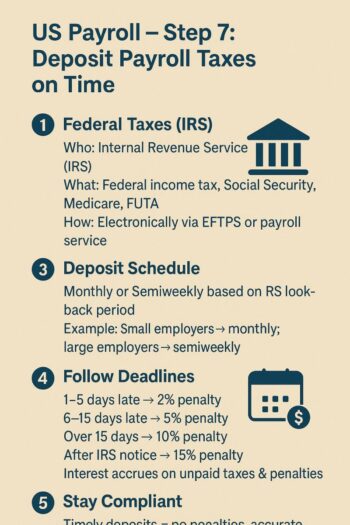
US Payroll – Step 7: Deposit Payroll Taxes on Time (to Federal Taxes (IRS) / State Taxes (State Agencies)

πŸ’Ό US Payroll – Step 8: Deposit Payroll Taxes on Time (to Federal Taxes (IRS) / State Taxes (State Agencies) πŸ’ΌUS Payroll – Payroll Tax Deposits :- 1️⃣ Federal Taxes (IRS): *Who: Internal Revenue Service (IRS) *What: Federal income tax withholding, Social Security, Medicare, FUTA *How: Electronically via EFTPS (Electronic Federal Tax Payment System) or through payroll service 2️⃣ State Taxes (State Agencies): *Who: Your state’s Department of Revenue or equivalent *What: State income tax withholding, State Unemployment Tax (SUTA) *How: Via the state’s online portal or approved electronic system πŸ’‘ Tip: Always check state-specific rules β€” each state has its own deposit schedule and payment methods 1️⃣ Know Your Deposit Schedule – Decide if you’re a monthly or semi-weekly depositor (based on your IRS lookback period). πŸ‘‰ Example: Small employers usually deposit monthly; large ones, semi-weekly. 2️⃣ Deposit Electronically – Use EFTPS (Electronic Federal Tax Payment System) or your payroll software to make payments securely. 3️⃣ Follow Strict Deadlines – IRS penalties apply for late deposits: 1) 1–5 days late β†’ 2% penalty 2) 6–15 days late β†’ 5% penalty 3) Over 15 days late β†’ 10% penalty After IRS notice β†’ 15% penalty πŸ’‘ Interest accrues on both unpaid tax and penalties until fully paid. 4️⃣ Stay Compliant – Timely deposits = no penalties, no stress, and clean payroll records!

US Payroll – Step 7: Deposit Payroll Taxes on Time (to Federal Taxes (IRS) / State Taxes (State Agencies) Read More Β»

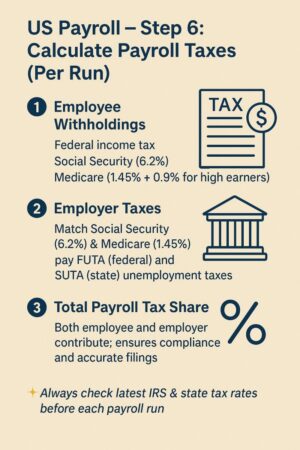
US Payroll – Step 6: Calculate Payroll Taxes (Per Run)

πŸ’Ό US Payroll – Step 6: Calculate Payroll Taxes (Per Run) 🧾 What It Means:- Payroll taxes are shared between employees and employers β€” covering federal income tax, Social Security, Medicare, and unemployment taxes. Example – just like in India where PF (Provident Fund) has both portions (employees and employers). The only difference in the US, this deduction is for taxes (Social Security & Medicare) instead of PF. Note: Federal income tax, Social Security, Medicare, and unemployment taxes are not retirement funds β€” they are taxes. (The PF example is only for easy understanding of how both employee and employer contribute.) 1️⃣ Employee Withholdings (deducted from employee pay) *Federal Income Tax – Based on W-4 form selections. *Social Security – 6.2% (up to annual wage limit). *Medicare – 1.45% (+0.9% extra for high earners). πŸ‘‰ Example: $1,000 pay β†’ $62 Social Security + $14.50 Medicare withheld. 2️⃣ Employer Taxes (paid by the employer) *Social Security (6.2%) + Medicare (1.45%) – Employer matches these amounts. *FUTA (Federal Unemployment Tax) – Employer only; report on Form 940. *SUTA (State Unemployment Tax) – Rate varies by state. πŸ‘‰ Example: Employer pays same 7.65% + unemployment taxes. ✨ Pro Tip: Always check the latest IRS and state tax rates before processing payroll β€” they change annually!

US Payroll – Step 6: Calculate Payroll Taxes (Per Run) Read More Β»

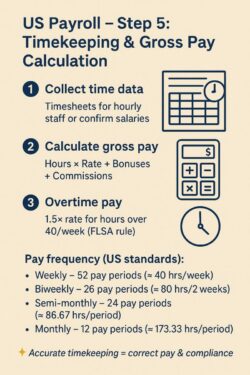
US Payroll – Step 5: Timekeeping & Gross Pay Calculation

πŸ’ΌUS Payroll – Step 5: Timekeeping & Gross Pay Calculation: – 1️⃣ Collect Time Data – Get timesheets/timecards for hourly staff or confirm salaries. πŸ‘‰ Example: Hourly employee logs 45 hours; salaried employee gets fixed pay. 2️⃣ Calculate Gross Pay – Hours Γ— Rate + Bonuses + Commissions + Taxable Reimbursements. πŸ‘‰ Example: 40 hrs Γ— $20 = $800 + $50 bonus = $850 gross pay. 3️⃣ Overtime Pay – 1.5Γ— regular rate for hours over 40/week (per FLSA). πŸ‘‰ Example: 5 overtime hrs Γ— $30 = $150 extra. 4️⃣ Pay Frequency (as per US payroll standards):- 1) Weekly: 52 pay periods per year (β‰ˆ 40 hrs/week) 2) Biweekly: 26 pay periods per year (β‰ˆ 80 hrs every 2 weeks) 3) Semi-monthly: 24 pay periods per year (β‰ˆ 86.67 hrs per period) 4) Monthly: 12 pay periods per year (β‰ˆ 173.33 hrs per period) ✨ Accurate timekeeping ensures correct pay, overtime, and tax calculations!

US Payroll – Step 5: Timekeeping & Gross Pay Calculation Read More Β»