Tax Credits

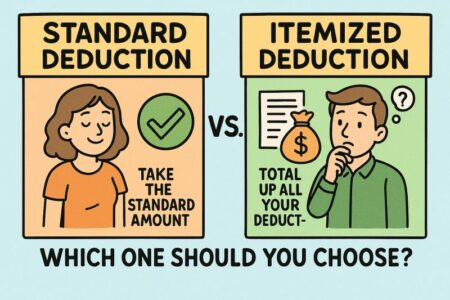
07c – Standard Deduction vs. Itemized Deduction โ€“ Which One Should You Choose?

๐Ÿงพ Standard Deduction vs. Itemized Deduction โ€“ Which One Should You Choose? When filing IRS Form 1040, you have two ways to reduce your taxable income: โœ… Standard Deduction โœ… Itemized Deductions (Schedule A) But you can claim only ONE. So, which is better for you? Letโ€™s break it down: ๐Ÿ”น Standard Deduction Fixed amount based on your filing status No receipts or proof required Quick and simple filing 2024 Standard Deduction (for 2025 filings): Single / Married Filing Separately: $14,600 Married Filing Jointly: $29,200 Head of Household: $21,900 โž• Additional: $1,550 per person (65+ or blind) ๐Ÿ”น Itemized Deductions (Schedule A) List actual deductible expenses instead of a flat amount Requires documentation (receipts, bills, Form 1098, donation letters, etc.) Common categories: โœ… Mortgage interest โœ… State & local taxes (SALT) โ€“ capped at $10,000 โœ… Charitable contributions โœ… Medical expenses (over 7.5% of AGI) โœ… Casualty losses (disaster areas) ๐Ÿ’ก Real-Life Example Case 1: Standard Deduction John is single with no mortgage, few medical bills, and small donations. Standard Deduction = $14,600 Itemized total = $6,000 (rent not deductible) โœ… John should take Standard Deduction Case 2: Itemized Deduction Sarah & Mike are married filing jointly, own a home, pay high property tax, and donate to charity. Mortgage interest = $15,000 SALT taxes = $10,000 (limit) Charitable contributions = $6,000 Total Itemized = $31,000 โœ… Sarah & Mike should itemize, since $31,000 > $29,200 โœ” Rule of Thumb: Take the option that gives you the bigger deduction. For most taxpayers, the Standard Deduction wins.

07c – Standard Deduction vs. Itemized Deduction โ€“ Which One Should You Choose? Read More ยป

US Payroll โ€“ Step 7: Deposit Payroll Taxes on Time (to Federal Taxes (IRS) / State Taxes (State Agencies)

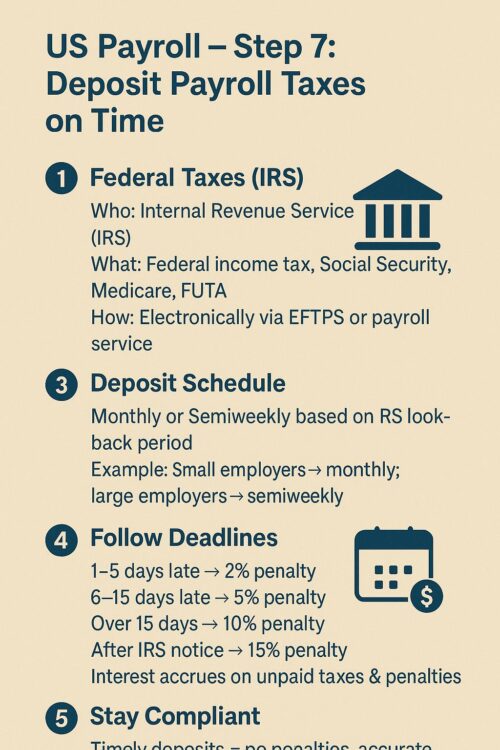
๐Ÿ’ผUS Payroll โ€“ Payroll Tax Deposits :- 1๏ธโƒฃ Federal Taxes (IRS): *Who: Internal Revenue Service (IRS) *What: Federal income tax withholding, Social Security, Medicare, FUTA *How: Electronically via EFTPS (Electronic Federal Tax Payment System) or through payroll service 2๏ธโƒฃ State Taxes (State Agencies): *Who: Your stateโ€™s Department of Revenue or equivalent *What: State income tax withholding, State Unemployment Tax (SUTA) *How: Via the stateโ€™s online portal or approved electronic system ๐Ÿ’ก Tip: Always check state-specific rules โ€” each state has its own deposit schedule and payment methods 1๏ธโƒฃ Know Your Deposit Schedule โ€“ Decide if youโ€™re a monthly or semi-weekly depositor (based on your IRS lookback period). ๐Ÿ‘‰ Example: Small employers usually deposit monthly; large ones, semi-weekly. 2๏ธโƒฃ Deposit Electronically โ€“ Use EFTPS (Electronic Federal Tax Payment System) or your payroll software to make payments securely. 3๏ธโƒฃ Follow Strict Deadlines โ€“ IRS penalties apply for late deposits: 1) 1โ€“5 days late โ†’ 2% penalty 2) 6โ€“15 days late โ†’ 5% penalty 3) Over 15 days late โ†’ 10% penalty After IRS notice โ†’ 15% penalty ๐Ÿ’ก Interest accrues on both unpaid tax and penalties until fully paid. 4๏ธโƒฃ Stay Compliant โ€“ Timely deposits = no penalties, no stress, and clean payroll records! ๐Ÿ‘‰ Stay connected for daily insights on US taxation.

US Payroll โ€“ Step 7: Deposit Payroll Taxes on Time (to Federal Taxes (IRS) / State Taxes (State Agencies) Read More ยป

03b – Topic: Taxability – Flow Through Entities

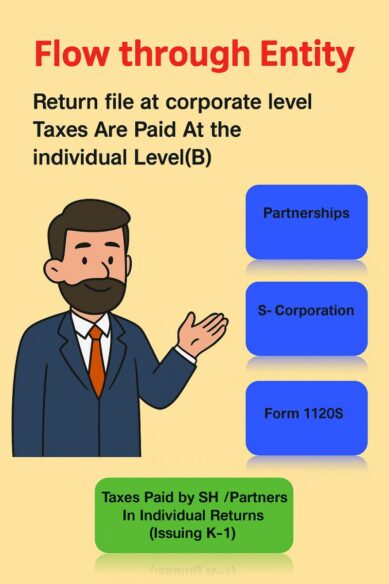
Topic: Taxability – Flow Through Entities Flow Through Entities play a unique role in taxation. โœ… Entities like Partnerships (Form 1065) and S-Corporations (Form 1120S) file returns at the corporate level. โœ… However, the taxes are paid at the individual level by shareholders or partners. โœ… Income passes through to individuals via Schedule K-1, and taxes are reported in their personal returns.

03b – Topic: Taxability – Flow Through Entities Read More ยป

01 – US taxation occurs at three levels

US taxation occurs at three levels (Taxation Levels in the US) 1.ย ย ย ย Federal Taxation (Central Government) oย ย ย Applies to all individuals and businesses in the US. oย ย ย Types: Income Tax, Corporate Tax, Payroll Tax, Excise Tax. oย ย ย Example: IRS collects income tax based on earnings. 2.ย ย ย ย State Taxation oย ย ย Applied by individual states. oย ย ย Types: State Income Tax, Sales Tax, State Corporate Tax. oย ย ย Example: California charges state income tax, but Florida does not. 3.ย ย ย ย Local Taxation (City/County) oย ย ย Levied by cities, counties, or municipalities. oย ย ย Types: Property Tax, Local Sales Tax, City Income Tax. oย ย ย Example: New York City charges an additional city income tax on residents.

01 – US taxation occurs at three levels Read More ยป

Notable Changes for Tax Year 2025 (Income tax returns to be filed starting tax season 2026)

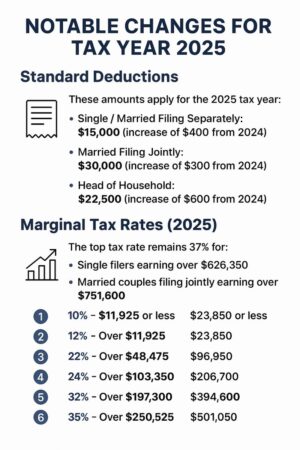
๐Ÿ’ก Notable Changes for Tax Year 2025 (Income tax returns to be filed starting tax season 2026) Standard deductions AND Marginal Tax rates:- These updates apply to income tax returns filed in 2026 (for the 2025 tax year) ๐Ÿงพ Standard Deductions: *Single / Married Filing Separately: $15,000 (increase of $400 from 2024) *Married Filing Jointly: $30,000 (increase of $800 from 2024) *Head of Household: $22,500 (increase of $600 from 2024) ๐Ÿ“Š Marginal Tax Rates (2025): The top tax rate remains 37% for: *Single filers earning over $626,350 *Married couples filing jointly earning over $751,600 Other rates and brackets: 1)ย 10% โ€“ $11,925 or less (single) / $23,850 or less (married joint) 2)ย 12% โ€“ Over $11,925 (single) / $23,850 (married joint) 3)ย 22% โ€“ Over $48,475 (single) / $96,950 (married joint) 4)ย 24% โ€“ Over $103,350 (single) / $206,700 (married joint) 5) ย 32% โ€“ Over $197,300 (single) / $394,600 (married joint) 6)ย 35% โ€“ Over $250,525 (single) / $501,050 (married joint)

Notable Changes for Tax Year 2025 (Income tax returns to be filed starting tax season 2026) Read More ยป

Form 3520 โ€“ Transactions with Foreign Trusts

๐Ÿ“‹ Form 3520 โ€“ Transactions with Foreign Trusts :- Annual Return To Report Transactions With Foreign Trusts and Receipt of Certain Foreign Gifts. ๐Ÿ“˜ Purpose:- Used by U.S. persons (citizens, residents, or entities) to report certain transactions with foreign trusts or receipt of large gifts or inheritances from foreign individuals or entities. ๐Ÿ“‹ You must file Form 3520 if you: 1๏ธโƒฃ Receive money or property from a foreign trust, 2๏ธโƒฃ Are the owner of a foreign trust under U.S. tax rules, 3๏ธโƒฃ Receive gifts or bequests from a non-U.S. person exceeding certain thresholds (e.g., $100,000 from an individual or $ 19,570ย from a corporation/partnership in 2025 โ€“ limits may change each year). โš ๏ธ Penalty for non-filing: Up to 35% of the gross reportable amount, so timely filing is very important. ๐Ÿ“… Due date: Same as the individual income tax return (Form 1040) โ€” usually April 15, with an automatic extension to October 15 if you file Form 4868.  

Form 3520 โ€“ Transactions with Foreign Trusts Read More ยป

Understanding the 5 Key Elements of Accounting

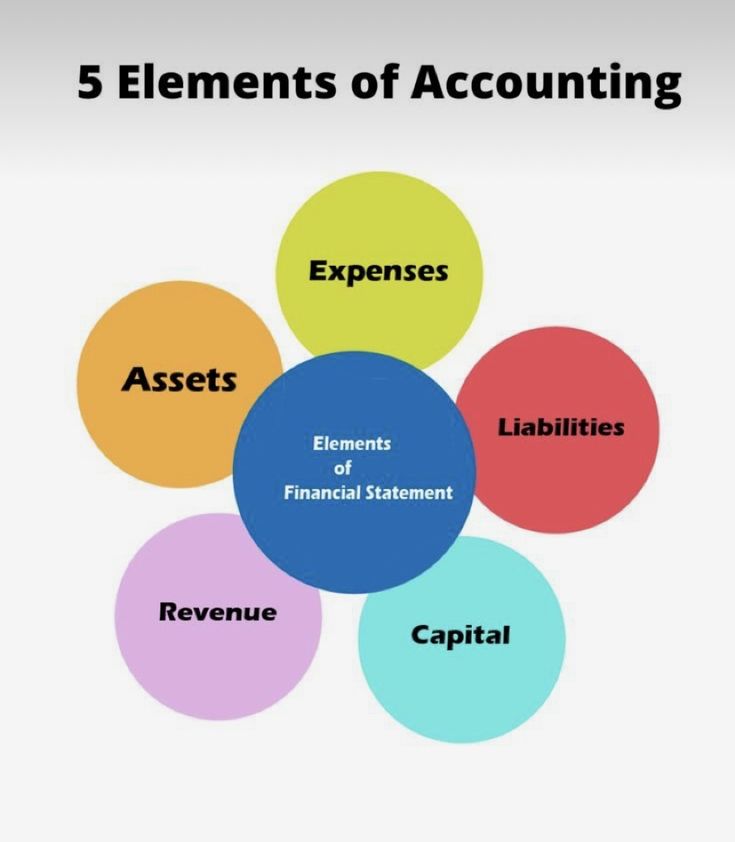
5 Major Elements of Accounting Accounting is the language of business, and its foundation rests on five key elements. Mastering these is essential for anyone in finance, management, or entrepreneurship. 1. #Assets Resources owned by a business that provide future economic benefits. Examples: Cash, Inventory, Equipment, Investments 2. #Liabilities Obligations a business owes to outsiders. These represent debts or payables. Examples: Loans, Accounts Payable, Taxes Payable 3. #Ownerโ€™s_Equity The residual interest in the assets after deducting liabilities โ€” simply, what belongs to the owners. Examples: Capital, Retained Earnings 4. #Revenue (Income) The inflows of money from business activities, increasing equity. Examples: Sales, Service Income, Interest Income 5. #Expenses The outflows incurred in generating revenue. They decrease equity. Examples: Salaries, Rent, Utilities, Depreciation At the heart of it all lies the golden rule: ๐Ÿ‘‰ Assets = Liabilities + Ownerโ€™s Equity

Understanding the 5 Key Elements of Accounting Read More ยป

W-2 โ†’ Wages, salaries, tips

Income-related forms (flow into 1040 Income section) :- 1099 series โ†’ ๐Ÿงพ 1099-NEC โ†’ Freelance / Contractor Income ๐Ÿ  1099-MISC โ†’ Rent, Royalties, Other Income ๐Ÿฆ 1099-INT โ†’ Interest ๐Ÿ“ˆ 1099-DIV โ†’ Dividends ๐Ÿ’น 1099-B โ†’ Stock / Brokerage Transactions ๐Ÿ‘ต SSA-1099 โ†’ Social Security Benefits ๐Ÿ“‚ 1099-R โ†’ Retirement / Pension Distributions โœ”๏ธ These forms flow directly into the Income section of Form 1040 โ€” essential for tax filing. ๐Ÿ‘‰ Stay connected for daily insights on US taxation.

W-2 โ†’ Wages, salaries, tips Read More ยป

๐—›๐—ผ๐˜„ ๐—”๐— ๐—ง ๐—ฃ๐—น๐—ฎ๐—ป๐—ป๐—ถ๐—ป๐—ด ๐—ฆ๐—ฎ๐˜ƒ๐—ฒ๐—ฑ $๐Ÿญ๐Ÿฑ,๐Ÿฑ๐Ÿณ๐Ÿฐ ๐—ถ๐—ป ๐—ง๐—ฎ๐˜…๐—ฒ๐˜€

Many high-income taxpayers donโ€™t realize that ignoring the Alternative Minimum Tax (AMT) can significantly increase their tax liability. Hereโ€™s a real-world style example: *Without planning, the taxpayer owed $85,424 under AMT. *With proper planning, liability was reduced to $69,850 โ€” a tax savings of $15,574. This case study breaks down: * Regular Tax Calculation * AMT Before Planning * AMT After Planning * Final Tax Savings Tax planning isnโ€™t about what you earn, but about what you keep.   [embeddoc url=”https://taxtium.com/wp-content/uploads/2025/09/document.pdf”]

๐—›๐—ผ๐˜„ ๐—”๐— ๐—ง ๐—ฃ๐—น๐—ฎ๐—ป๐—ป๐—ถ๐—ป๐—ด ๐—ฆ๐—ฎ๐˜ƒ๐—ฒ๐—ฑ $๐Ÿญ๐Ÿฑ,๐Ÿฑ๐Ÿณ๐Ÿฐ ๐—ถ๐—ป ๐—ง๐—ฎ๐˜…๐—ฒ๐˜€ Read More ยป