US Taxation: A Quick Guide for Beginners!

11h – Schedule SE – Self-Employment Tax (Attach to Form 1040)

📘 Schedule SE – Self-Employment Tax (Attach to Form 1040):- 🔹 Purpose :- Schedule SE is used to figure and report self-employment tax (Social Security and Medicare taxes) for individuals who work for themselves. 🔹 Who Must File: You must file Schedule SE if you had: *Net earnings of $400 or more from self-employment. *Church employee income of $108.28 or more (special rule). 🔹 What It Covers : *Social Security tax – 12.4% on self-employment income (up to wage base limit). *Medicare tax – 2.9% on all self-employment income. *Additional Medicare tax – 0.9% if income exceeds $200k (single) / $250k (married). ✅ Total SE Tax = 15.3% (Social Security + Medicare). 🔹 Special Notes : *You can deduct half of your SE tax as an adjustment to income on Form 1040, Schedule 1. *Income reported on Schedule C (business), Schedule F (farm), or Schedule K-1 often flows into Schedule SE. *Even if you owe no income tax, you may still owe SE tax. 👉 In short: Schedule SE = how freelancers, gig workers, and small business owners pay Social Security & Medicare taxes.

11h – Schedule SE – Self-Employment Tax (Attach to Form 1040) Read More »
11g – Schedule H – Household Employment Taxes (Attach to Form 1040)

📘 Schedule H – Household Employment Taxes (Attach to Form 1040):- 🔹 Purpose: Schedule H is used by taxpayers who employ household workers (like nannies, caregivers, housekeepers, or gardeners) to report and pay: *Social Security and Medicare taxes (FICA) *Federal unemployment tax (FUTA) *Federal income tax withheld (if any) 🔹 Who Must File:- You must file Schedule H if you: *Paid a household employee $2,700 or more in cash wages (2024 threshold). *Withheld federal income tax from a household employee. *Paid $1,000 or more in any quarter for FUTA wages. 🔹 What to Report : 1.   Total cash wages paid to household employees. 2.   Employer’s share of Social Security & Medicare tax. 3.   Employee’s share of Social Security & Medicare tax (if withheld). 4.   FUTA tax due. 5.   Any federal income tax withheld. 🔹 Special Notes: 1-Taxes are reported on Schedule H, then carried to Form 1040, Schedule 2. 2-Household employers don’t file Form W-2 for contractors (like landscapers hired via a company)—only for direct employees. 3-Filing Form W-2 & W-3 with the SSA is also required for each household employee. 👉 In short: Schedule H = for household employers to report nanny tax, caregiver tax, or other household worker taxes.

11g – Schedule H – Household Employment Taxes (Attach to Form 1040) Read More »

11f – Schedule F – Profit or Loss From Farming (Attach to Form 1040)

📘 Schedule F – Profit or Loss From Farming (Attach to Form 1040) :- 🔹 Purpose : Schedule F is used by farmers to report farm income and expenses. It helps determine the net profit or loss from operating a farming business. 🔹 What to Report on Schedule F : 1.   Farm Income – Sales of livestock, produce, grains, and other products. – Cooperative distributions. – Agricultural program payments. – Crop insurance proceeds. – Custom hire (machine work) income. 2.   Farm Expenses (deductible) – Seeds and plants. – Fertilizers and lime. – Labor hired (wages). – Feed and veterinary costs. – Equipment repairs and fuel. – Insurance, mortgage interest, utilities, and depreciation. 3.   Net Profit or Loss – Net income is subject to income tax and possibly self-employment tax. 🔹 Who Must File : *Individuals or sole proprietors who operate a farm for profit. *Includes crop farms, livestock farms, dairy, poultry, fish farms, orchards, and plantations. 🔹 Special Notes : Form 4835 is used instead if you’re a landlord receiving crop/livestock shares but not materially participating in farm operations. Farmers may be eligible for special tax rules (e.g., estimated tax payments due dates, farm income averaging). 👉 In short: Schedule F = the farmer’s business income statement for taxes.

11f – Schedule F – Profit or Loss From Farming (Attach to Form 1040) Read More »

11e – Schedule E – Supplemental Income and Loss (Attach to Form 1040/1040-SR)

📘 Schedule E – Supplemental Income and Loss (Attach to Form 1040/1040-SR) :- 🔹 Purpose : Used to report income or loss from sources other than wages or self-employment, such as:- 1.   Rental Real Estate – Houses, apartments, condos, land, etc. 2.   Royalties – Payments for copyrights, patents, oil/gas/mineral rights. 3.   Partnerships & S Corporations – Your share of pass-through income/loss (via Schedule K-1). 4.   Estates & Trusts – Income received as a beneficiary. 5.   REMICs (Real Estate Mortgage Investment Conduits) – Residual interests. 🔹 Key Information on the Form :- *Property addresses (for rentals) *Rental income & expenses (mortgage interest, repairs, property taxes, etc.) *Royalties received *Pass-through income from Schedule K-1 *Net income or loss carried to Form 1040, Schedule 1 📅 Filing Attached to Form 1040/1040-SR during tax filing. Deadline follows Form 1040 due dates (April 15, or Oct 15 with extension). ✅ Tip: If you have active participation in rental property (e.g., approving tenants, managing property), you may deduct up to $25,000 of losses, subject to income limits.

11e – Schedule E – Supplemental Income and Loss (Attach to Form 1040/1040-SR) Read More »

11d – Schedule D – Capital Gains and Losses (Form 1040)

📘 Schedule D – Capital Gains and Losses (Form 1040) :- 🔹 Purpose :- Schedule D is used by individuals to report capital gains and losses from the -*sale or exchange of: *Stocks, bonds, mutual funds *Real estate (not used in business) *Partnership/LLC interests *Other capital assets It helps calculate the net capital gain or deductible capital loss, which then flows to Form 1040. 🔹 When to File :- You must file Schedule D if you had: *Sales/exchanges of capital assets *Capital gain distributions (reported on Form 1099-DIV) *Non-business bad debts *A carryover of capital loss from a prior year 🔹 Structure of Schedule D :- 1.   Part I – Short-Term Capital Gains and Losses (held ≤ 1 year) – Reports sales of assets held 1 year or less – Uses ordinary income tax rates 2.   Part II – Long-Term Capital Gains and Losses (held > 1 year) – Reports sales of assets held more than 1 year – Eligible for preferential tax rates (0%, 15%, or 20%) 3.   Part III – Summary – Combines short- and long-term results – Applies limitations (e.g., $3,000 annual capital loss deduction for individuals) – Determines if you have carryover to future years 🔹 Where It Flows :- The net capital gain/loss from Schedule D is transferred to Form 1040, Schedule 1, Line 7, and ultimately impacts your taxable income. 🔹 Example *You bought 100 shares of Apple at $100 = $10,000. *Sold them for $14,000 after 2 years → $4,000 long-term gain. *You also sold Tesla shares at a $1,500 short-term loss. On Schedule D: Part I → Report Tesla loss (-$1,500) Part II → Report Apple gain (+$4,000) Part III → Net gain = $2,500 → taxed as long-term capital gain 👉 In short: Schedule D summarizes all your capital gains/losses and determines the final taxable/net capital gain to be included in your return.

11d – Schedule D – Capital Gains and Losses (Form 1040) Read More »

11c – Schedule C – Profit or Loss from Business (Sole Proprietorship)

📘 Schedule C – Profit or Loss from Business (Sole Proprietorship):- 🔹 Purpose :- Schedule C is used by self-employed individuals, freelancers, independent contractors, and sole proprietors to report income and expenses from their business. 🔹 Who Must File? You need Schedule C if you:- *Run a business as a sole proprietor *Work as an independent contractor (e.g., Uber driver, freelancer, consultant) *Have side business income apart from your wages/salary 🔹 Key Information Reported:- 1.   Gross Receipts (Income) – Total business income earned 2.   Business Expenses – Deductible costs like: – Office supplies, rent, utilities – Advertising & marketing – Vehicle mileage & travel – Employee wages & contract labor – Depreciation of assets 3.   Net Profit or Loss – Income minus expenses → reported on Form 1040, Schedule 1 🔹 Example *Freelance designer earns $50,000 *Deductible expenses (software, laptop, internet, marketing, etc.): $15,000 *Net income = $35,000 → Reported on Schedule C and carried to Form 1040 📆 Deadline Attach with Form 1040 → Due April 15 (or extended date if Form 4868 is filed). 👉 Tip: Keep detailed records of all income & receipts to maximize deductions and avoid IRS issues.

11c – Schedule C – Profit or Loss from Business (Sole Proprietorship) Read More »

11b – Schedule B – Interest and Ordinary Dividends (Attach to Form 1040/1040-SR)

📘 Schedule B – Interest and Ordinary Dividends (Attach to Form 1040/1040-SR):- 🔹 Purpose :- Reports taxable interest and dividend income exceeding certain thresholds. 🔹 Key Points :- 1.   Part I – Interest income (bank accounts, bonds, notes). 2.   Part II – Ordinary dividend income (stocks, mutual funds). 🔹 When Required :- You must file Schedule B if: • Interest > $1,500 • Dividends > $1,500 • Foreign accounts/trusts involved • You receive dividends as a nominee. 🔹 Why It Matters :- Ensures proper taxation of passive income and compliance with foreign account reporting rules. 📅 Filing Attach with Form 1040/1040-SR when thresholds are met.

11b – Schedule B – Interest and Ordinary Dividends (Attach to Form 1040/1040-SR) Read More »

11a – Schedule A – Itemized Deductions (Claim with Form 1040)

📘 Schedule A – Itemized Deductions (Claim with Form 1040):- 🔹 Purpose Used to report itemized deductions instead of taking the standard deduction on Form 1040. 🔹 Common Deductions Allowed:- 1.   Medical & Dental Expenses – If above 7.5% of AGI 2.   State & Local Taxes (SALT) – Up to $10,000 3.   Home Mortgage Interest – On qualifying loans 4.   Charitable Contributions – Cash & non-cash donations 5.   Casualty & Theft Losses – In federally declared disasters 6.   Miscellaneous Deductions – Only if allowed by IRS rules 🔹 When to Use:- • If your itemized deductions > standard deduction • Common for homeowners, high-tax states, or those with large medical/charity expenses 📅 Deadline • Filed with Form 1040 by April 15 (or Oct 15 with extension) 👉 Example: *If your SALT = $8,000, Mortgage Interest = $12,000, and Charity = $3,000, Total = $23,000. *Since this is greater than 2024 standard deduction ($14,600 single / $29,200 married), you would itemize.

11a – Schedule A – Itemized Deductions (Claim with Form 1040) Read More »

11 – List of Schedules Use with Form 1040 and Their Uses:-

Schedule A – Itemized Deductions : – For claiming actual deductible expenses like medical, mortgage interest, state taxes, charitable donations, etc. Schedule B – Interest and Ordinary Dividends :- For reporting taxable interest and dividend income. Schedule C – Profit or Loss from Business :- For self-employed individuals or sole proprietors. Schedule D – Capital Gains and Losses :- For reporting sales of investments, stocks, bonds, real estate. Schedule E – Supplemental Income and Loss :- For rental real estate, royalties, partnerships, S corporations, trusts. Schedule F – Profit or Loss from Farming :- For farmers reporting income and expenses from farming activities. Schedule H – Household Employment Taxes :- For individuals who employ household workers (e.g., nannies, housekeepers). Schedule SE – Self-Employment Tax :- For calculating Social Security and Medicare tax on self-employment income. Schedule 1 – Additional Income and Adjustments to Income :- For reporting unemployment, gambling winnings, alimony (pre-2019), educator expenses, IRA deductions, student loan interest. Schedule 2 – Additional Taxes :- For alternative minimum tax (AMT), excess advance premium tax credit repayment. Schedule 3 – Additional Credits and Payments :- For non-refundable credits (education, foreign tax) and refundable credits. 💡 Note: Not all taxpayers need every schedule. You only attach the schedules that apply to your tax situation.

11 – List of Schedules Use with Form 1040 and Their Uses:- Read More »

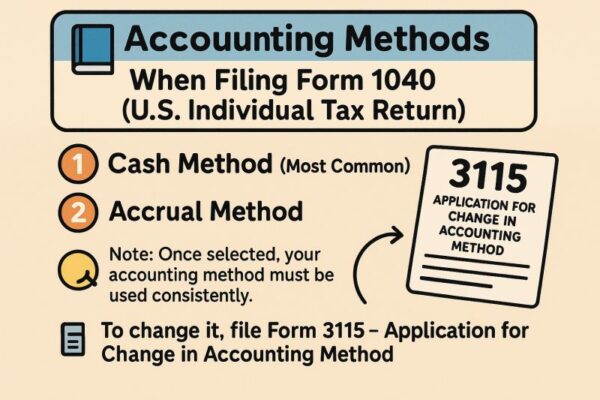
10 – Accounting Methods When Filing Form 1040 (U.S. Individual Tax Return)

📘 Accounting Methods When Filing Form 1040 (U.S. Individual Tax Return) When reporting income and expenses, the IRS allows individuals to use one of the following accounting methods: 1️⃣ Cash Method (Most Common) ✅ Income is reported when received ✅ Expenses are deducted when paid 🧾 Simple and ideal for employees, freelancers & small businesses 2️⃣ Accrual Method 📊 Income is reported when earned (even if not received) 📉 Expenses are deducted when incurred 🔍 Typically used by businesses with inventory or complex operations 3️⃣ Hybrid Method 🔄 A mix of cash & accrual 📦 Common for businesses tracking inventory (e.g., accrual for sales, cash for expenses) 🔄 Note: Once selected, your accounting method must be used consistently. 📄 To change it, file Form 3115 – Application for Change in Accounting Method

10 – Accounting Methods When Filing Form 1040 (U.S. Individual Tax Return) Read More »