October 2025

06g – Form 1099-G – Certain Government Payments (Unemployment Benefits):-

πŸ“˜ Form 1099-G – Certain Government Payments (Unemployment Benefits):- Form 1099-G is issued by federal, state, or local governments to taxpayers who received certain types of government payments during the year. It helps ensure that individuals report these amounts as income when filing their Form 1040 (U.S. Individual Income Tax Return). πŸ”Ή Common Situations Where You Receive Form 1099-G 1.Β Β Β Unemployment Compensation – If you received unemployment benefits, the total amount is reported on 1099-G (must be included as taxable income). 2.Β Β Β State or Local Tax Refunds, Credits, or Offsets – Reported if you itemized deductions in the prior year. 3.Β Β Β Agricultural Payments – Farmers receiving subsidies or grants. 4.Β Β Β Taxable Grants – Government research grants or other taxable aid. 5.Β Β Β Reemployment Trade Adjustment Assistance (RTAA) Payments. πŸ”Ή Key Details *Issuer: Government agency (state, federal, or local). *Recipient: Taxpayer who received the payment. *IRS Copy: Sent directly to IRS to match with your return. πŸ“… Deadline to Receive: By January 31 of the following year. πŸ’‘ Example: If you received $8,000 in unemployment benefits in 2024, you’ll get Form 1099-G in early 2025, and must report that income on Form 1040, Schedule 1. βœ… Remember Even though it comes from the government, most payments on Form 1099-G are taxable. Always review it carefully when filing your return.  

06g – Form 1099-G – Certain Government Payments (Unemployment Benefits):- Read More Β»

06f – Form 1099-MISC vs. Form 1099-NEC

πŸ“„ Form 1099-MISC vs. Form 1099-NEC :- Both forms are used to report non-wage payments, but they serve different purposes after the IRS split reporting in 2020. πŸ” Form 1099-MISC – Miscellaneous Information πŸ” Form 1099-NEC – Nonemployee Compensation πŸ“Š Form 1099-MISC vs. Form 1099-NEC – Key Differences πŸ”Ή Purpose *1099-MISC β†’ Reports miscellaneous payments (rent, royalties, prizes, legal settlements, etc.) *1099-NEC β†’ Reports nonemployee compensation (independent contractors, freelancers, gig workers) πŸ”Ή Payment Types *1099-MISC β†’ Rent, royalties, awards, certain attorney fees, other income over $600 *1099-NEC β†’ Services performed by nonemployees, $600+ payments for freelance/contract work πŸ”Ή Who Gets It *1099-MISC β†’ Landlords, attorneys, prize winners, royalty earners, etc. *1099-NEC β†’ Freelancers, consultants, service providers, gig workers πŸ”Ή Filing Deadline *1099-MISC β†’ To Recipient: January 31 To IRS: Feb 28 (Paper) / Mar 31 (E-file) *1099-NEC β†’ To Recipient & IRS: January 31 (same for both) πŸ”Ή IRS Change (Since 2020) Before 2020, nonemployee compensation was reported on 1099-MISC (Box 7). Now, it must be reported separately on 1099-NEC. πŸ’‘ Example: – Paid $10,000 to a contractor β†’ Report on 1099-NEC – Paid $15,000 office rent β†’ Report on 1099-MISC

06f – Form 1099-MISC vs. Form 1099-NEC Read More Β»

06e – Form 1099-DIV – Dividends and Distributions

πŸ“„ Form 1099-DIV – Dividends and Distributions:- Form 1099-DIV is an IRS tax form used to report dividends and certain distributions paid to taxpayers by banks, corporations, mutual funds, and other financial institutions. If you earned $10 or more in dividends during the year, the payer must issue this form. πŸ” Key Points:- 1️⃣ Who issues it? β€’ Corporations, mutual funds, ETFs, brokers, and other investment companies. 2️⃣ Who receives it? β€’ Investors who earned taxable dividends or capital gains distributions. 3️⃣ What does it contain? β€’ Ordinary dividends β€’ Qualified dividends (taxed at lower capital gains rates) β€’ Capital gain distributions β€’ Non-dividend distributions (return of capital) β€’ Federal income tax withheld (if applicable) 4️⃣ When is it issued? β€’ Must be provided to taxpayers by January 31 of the following year. 5️⃣ Why is it important? β€’ Dividend income must be reported on Form 1040, often with Schedule B if over $1,500. β€’ The IRS uses it to verify your reported investment income. πŸ’‘ Example: If you own shares in a mutual fund and receive $200 in qualified dividends and $50 in capital gain distributions in 2024, you’ll get Form 1099-DIV from the fund by January 31, 2025 to report on your 2024 tax return. βœ… Tip: Qualified dividends may be taxed at a lower rate, so reporting them correctly can reduce your tax bill.  

06e – Form 1099-DIV – Dividends and Distributions Read More Β»

06d – Form 1099-INT – Interest Income

πŸ“„ Form 1099-INT – Interest Income Form 1099-INT is an IRS tax form used to report interest income you earned during the year. Banks, credit unions, brokerage firms, and other financial institutions issue it if they paid you $10 or more in interest. πŸ” Key Points 1️⃣ Who issues it? β€’ Financial institutions (banks, brokerages, credit unions, etc.). 2️⃣ Who receives it? β€’ Individuals or businesses that earned taxable interest. 3️⃣ What does it contain? β€’ Total interest income earned β€’ Tax-exempt interest (if any) β€’ Federal income tax withheld (if backup withholding applied) β€’ Early withdrawal penalties (if applicable) 4️⃣ When is it issued? β€’ Must be sent to taxpayers by January 31 of the following year. 5️⃣ Why is it important? β€’ You must report interest income on your Form 1040. β€’ The IRS receives a copy to verify your tax filing. πŸ’‘ Example: If your savings account earned $250 in 2024 interest, your bank will send you a Form 1099-INT by January 31, 2025 to include in your 2024 tax return. βœ… Tip: Even if you don’t receive a 1099-INT (e.g., interest under $10), you are still required to report all taxable interest.

06d – Form 1099-INT – Interest Income Read More Β»

06c1 – Form W-2 Explained (Withholding Tax)

πŸ“˜ What is Form W-2 ? Employers in the U.S. give Form W-2, Wage and Tax Statement to employees each year. It shows income earned and taxes withheld from pay checks. 🏦 Withholding Tax (shown on W-2) :- When you earn wages, your employer withholds certain taxes from your pay check and reports them on your W-2: 1.Β Β Β Federal Income Tax Withheld (Box 2) oΒ Β Based on IRS tax tables and the information you gave on Form W-4. 2.Β Β Β Social Security Tax Withheld (Box 4) oΒ Β 6.2% of wages (up to annual wage base limit). 3.Β Β Β Medicare Tax Withheld (Box 6) oΒ Β 1.45% of wages (no limit, plus 0.9% extra if income is high). 4.Β Β Β State & Local Taxes Withheld (Boxes 17 & 19, if applicable) oΒ Β Based on your state/local income tax rules. πŸ‘‰ At year-end, when you file your Form 1040, the amounts withheld on the W-2 are credited against your total tax liability.

06c1 – Form W-2 Explained (Withholding Tax) Read More Β»

06c – Form W-2 – Wage and Tax Statement (Summary of Wages/paycheck)

πŸ“„ Form W-2 – Wage and Tax Statement (Summary of Wages/paycheck) Form W-2 is an IRS tax form that employers must provide to employees each year. It reports the employee’s annual wages and the taxes withheld from their paycheck . πŸ” Key Points 1️⃣ Who issues it? β€’ Employers send it to both the employee and the IRS. 2️⃣ Who receives it? β€’ All employees (not independent contractors β€” they get Form 1099-NEC). 3️⃣ What does it contain? β€’ Total wages, tips, and other compensation β€’ Federal income tax withheld β€’ Social Security and Medicare taxes withheld β€’ State/local taxes withheld (if applicable) β€’ Employer & employee identifying information 4️⃣ When is it issued? β€’ Employers must send Form W-2 by January 31 of the following year. 5️⃣ Why is it important? β€’ Employees use it to file Form 1040 for their income tax return. β€’ The IRS matches your tax return against W-2 data to ensure accuracy. πŸ’‘ Example: If you worked for a company in 2024, you should receive your W-2 by January 31, 2025, to report your wages and withholdings for your 2024 tax return. βœ… Tip: Always check your W-2 for accuracy. If there’s an error, request a corrected version (Form W-2c).

06c – Form W-2 – Wage and Tax Statement (Summary of Wages/paycheck) Read More Β»

06b – Income Documents

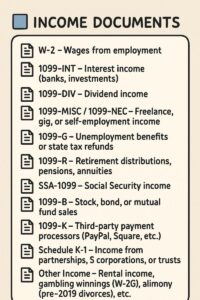
🧾 Filing IRS Form 1040 (Individual Return) Don’t Forget These Key Supporting Documents! While the IRS doesn’t require you to submit all documents with your Form 1040, you must keep them for your records β€” especially in case of an audit or income verification. Here’s a checklist of commonly required documents based on income types: πŸ”Ή INCOME DOCUMENTS πŸ“„ W-2 – Wages from employment 1099 series β†’ πŸ“„ 1099-INT – Interest income (banks, investments) πŸ“„ 1099-DIV – Dividend income πŸ“„ 1099-MISC / 1099-NEC – Freelance, gig, or self-employment income πŸ“„ 1099-G – Unemployment benefits or state tax refunds πŸ“„ 1099-R – Retirement distributions, pensions, annuities πŸ“„ SSA-1099 – Social Security income πŸ“„ 1099-B – Stock, bond, or mutual fund sales πŸ“„ 1099-K – Third-party payment processors (PayPal, Square, etc.) πŸ“„ Schedule K-1 – Income from partnerships, S corporations, or trusts πŸ“„ Other Income – Rental income, gambling winnings (W-2G), alimony (pre-2019 divorces), etc. βœ”οΈ These forms flow directly into the Income section of Form 1040 β€” essential for tax filing. πŸ’‘ Tip: Keep digital or physical copies organized by category β€” this will save you time and stress later!  

06b – Income Documents Read More Β»

US Payroll – Step 7: Deposit Payroll Taxes on Time (to Federal Taxes (IRS) / State Taxes (State Agencies)

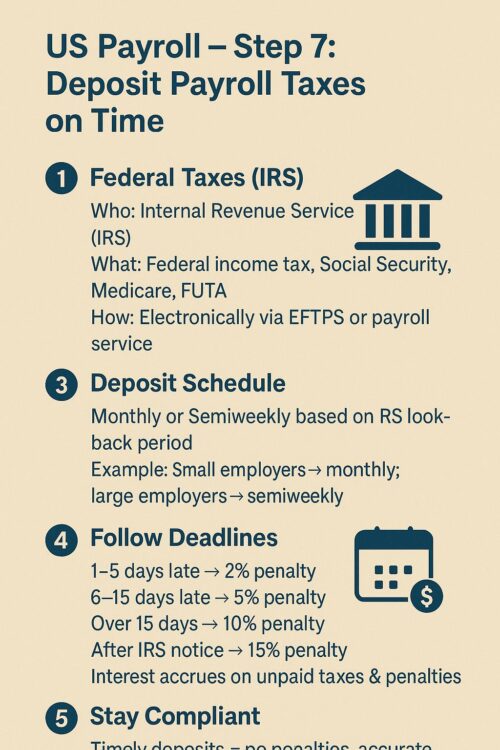
πŸ’ΌUS Payroll – Payroll Tax Deposits :- 1️⃣ Federal Taxes (IRS): *Who: Internal Revenue Service (IRS) *What: Federal income tax withholding, Social Security, Medicare, FUTA *How: Electronically via EFTPS (Electronic Federal Tax Payment System) or through payroll service 2️⃣ State Taxes (State Agencies): *Who: Your state’s Department of Revenue or equivalent *What: State income tax withholding, State Unemployment Tax (SUTA) *How: Via the state’s online portal or approved electronic system πŸ’‘ Tip: Always check state-specific rules β€” each state has its own deposit schedule and payment methods 1️⃣ Know Your Deposit Schedule – Decide if you’re a monthly or semi-weekly depositor (based on your IRS lookback period). πŸ‘‰ Example: Small employers usually deposit monthly; large ones, semi-weekly. 2️⃣ Deposit Electronically – Use EFTPS (Electronic Federal Tax Payment System) or your payroll software to make payments securely. 3️⃣ Follow Strict Deadlines – IRS penalties apply for late deposits: 1) 1–5 days late β†’ 2% penalty 2) 6–15 days late β†’ 5% penalty 3) Over 15 days late β†’ 10% penalty After IRS notice β†’ 15% penalty πŸ’‘ Interest accrues on both unpaid tax and penalties until fully paid. 4️⃣ Stay Compliant – Timely deposits = no penalties, no stress, and clean payroll records! πŸ‘‰ Stay connected for daily insights on US taxation.

US Payroll – Step 7: Deposit Payroll Taxes on Time (to Federal Taxes (IRS) / State Taxes (State Agencies) Read More Β»

06a – Topic: Concept of Income – What’s Taxable Income vs. Non-Taxable Income?

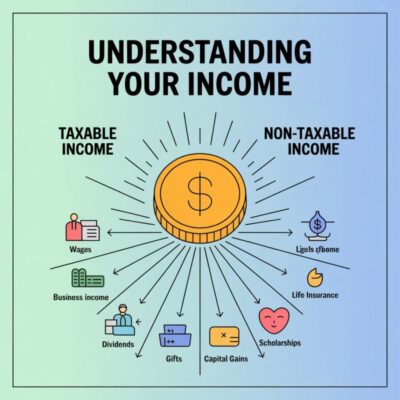
Topic: Concept of Income – What’s Taxable Income vs. Non-Taxable Income? Understanding what counts as income is essential for proper tax filing in the US πŸ”Ή 1. Types of Taxable Income:- βœ… Wages, Salaries, Tips βœ… Business/Professional Income βœ… Interest & Dividends βœ… Rental Income βœ… Capital Gains βœ… Unemployment Benefits βœ… Social Security (sometimes taxable) πŸ”Ή 2. Types of Non-Taxable Income:- ❌ Life Insurance Proceeds (if due to death) ❌ Gifts & Inheritances ❌ Child Support Payments ❌ Municipal Bond Interest ❌ Certain Scholarships/Fellowships ❌ Welfare & Public Assistance πŸ’‘ Tip: Not all income is treated equally β€” always check IRS rules or consult a tax professional for proper classification.

06a – Topic: Concept of Income – What’s Taxable Income vs. Non-Taxable Income? Read More Β»

05 – Topic: Filing Requirements – Who Must File a Tax Return for 2025?

Topic: Filing Requirements – Who Must File a Tax Return? βœ… You must file a return if: πŸ”Ή You are a US citizen who lived in or earned income from a US πŸ”Ή You want to claim a tax refund or avail tax credits (even if you’re not required to file otherwise). πŸ’‘ Tip: Even if your income is below the filing threshold, filing might benefit you by getting back withheld taxes or claiming refundable credits like EITC or CTC.

05 – Topic: Filing Requirements – Who Must File a Tax Return for 2025? Read More Β»