General

The new tax season coming up

The new tax season coming up and the number of NRAs increasing every year. 𝗟𝗲𝘁𝘀 𝗹𝗲𝗮𝗿𝗻 𝗮𝗹𝗹 𝗮𝗯𝗼𝘂𝘁 𝗜𝗧𝗜𝗡 𝘁𝗼𝗱𝗮𝘆- An Individual Taxpayer Identification Number (ITIN) is a nine-digit number issued by the Internal Revenue Service (IRS) to individuals who are required to have a taxpayer identification number but are not eligible for a Social Security Number (SSN). ITINs are used for tax reporting purposes and are primarily issued to non-resident aliens, their spouses, and dependents who do not qualify for an SSN. 𝗣𝘂𝗿𝗽𝗼𝘀𝗲 𝗼𝗳 𝗜𝗧𝗜𝗡: • The ITIN allows individuals to file tax returns and pay taxes even if they do not have an SSN. • It is used for federal tax reporting, including filing individual income tax returns (Form 1040) and other related forms. • ITINs help the IRS track taxpayers and their reporting, regardless of immigration status. 𝙒𝙝𝙤 𝙉𝙚𝙚𝙙𝙨 𝙖𝙣 𝙄𝙏𝙄𝙉? • Non-resident aliens who are required to file a tax return in the U.S. • U.S. residents who are not eligible for an SSN (e.g., certain immigrants or foreign nationals). • Dependents or spouses of U.S. citizens or resident aliens who need to be listed on tax returns. • Foreign nationals who have a U.S. income source but are not U.S. citizens or residents. 𝗛𝗼𝘄 𝘁𝗼 𝗔𝗽𝗽𝗹𝘆 𝗳𝗼𝗿 𝗮𝗻 𝗜𝗧𝗜𝗡: • To apply for an ITIN, individuals must submit Form W-7, Application for IRS Individual Taxpayer Identification Number, to the IRS. • The application requires documentation that proves the individual’s foreign status and identity (such as a passport, national identification card, or foreign birth certificate). • The application can be submitted with a federal income tax return or separately if the individual does not need to file a return immediately. 𝗗𝗼𝗰𝘂𝗺𝗲𝗻𝘁𝗮𝘁𝗶𝗼𝗻 𝗥𝗲𝗾𝘂𝗶𝗿𝗲𝗺𝗲𝗻𝘁𝘀: Applicants must provide original documents or certified copies from the issuing agency to support their foreign status and identity. Common documents include: 1. Passport (most common document to support both identity and foreign status) 2. National identification card 3. U.S. visa or immigration documents 4. Birth certificate or other government-issued documents These documents must be submitted with the Form W-7 application. 𝗜𝗧𝗜𝗡 𝗮𝗻𝗱 𝗘𝘅𝗽𝗶𝗿𝗮𝘁𝗶𝗼𝗻: ITINs do not expire unless they are not used on a U.S. tax return for three consecutive years. 𝗨𝘀𝗲𝘀 𝗼𝗳 𝗜𝗧𝗜𝗡: 1. Filing U.S. income tax returns (Form 1040, 1040-NR, etc.). 2. Claiming tax benefits, such as the Child Tax Credit or Additional Child Tax Credit (in certain cases). 3. Reporting income to the IRS from U.S. sources. 4. Filing other IRS forms such as the Form 1040-ES for estimated taxes.

The new tax season coming up Read More »

IRS Forms Due on January 31st: Stay Ahead of Your Tax Deadlines!

1.   Form W-2: – Meaning: Wage and Tax Statement. – Purpose: Reports wages paid to employees and taxes withheld. – Eligibility: Employers must file for each employee. – Due Date: Submit to employees and the SSA by Jan 31. 2.   Form 1099-NEC: – Meaning: Nonemployee Compensation. –  Purpose: Reports payments of $600+ to independent contractors. –  Eligibility: Businesses paying freelancers or contractors. –  Due Date: Submit to contractors and the IRS by Jan 31. 3.   Form 1099-MISC: –   Meaning: Miscellaneous Income. –   Purpose: Reports various payments like rents, royalties, or prizes. –   Eligibility: Businesses making payments of $600+ for these categories. –   Due Date: Jan 31 if reporting nonemployee compensation; otherwise, Feb 28 (paper) or March 31 (e-file). 4.   Form 940: –  Meaning: Employer’s Annual Federal Unemployment (FUTA) Tax Return. –  Purpose: Reports and pays unemployment taxes. –  Eligibility: Employers who paid wages of $1,500+ in a calendar quarter or had an employee for at least 20 weeks. –  Due Date: Jan 31 if no balance is due; Feb 10 if taxes were deposited on time. ✅ Plan Ahead: Missing these deadlines may result in penalties. Be proactive in preparing your forms!

IRS Forms Due on January 31st: Stay Ahead of Your Tax Deadlines! Read More »

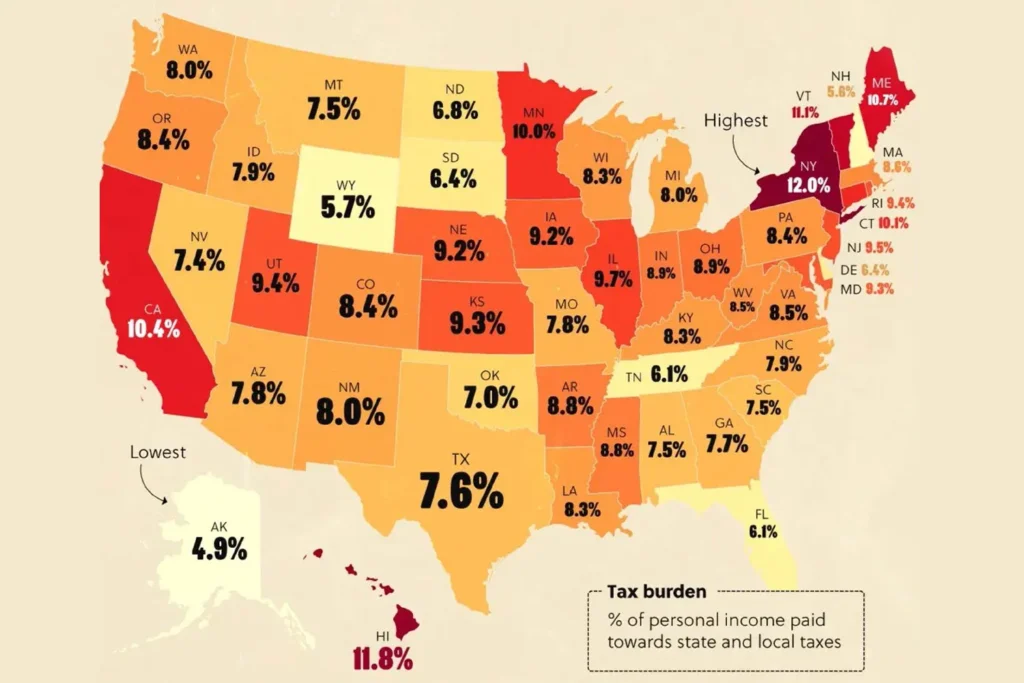
Taxation Across All 50 States: A Quick Overview of U.S. State Tax Systems

Understanding the differences in state taxes is crucial for both individuals and businesses. Each U.S. state has unique tax policies that can affect your finances. Here’s a breakdown of how different states approach key taxes: 1. Income Tax: 👉No State Income Tax: Alaska, Florida, Nevada, South Dakota, Texas, Washington, Wyoming 👉States with Progressive Income Tax (rates increase with income): California, New York, New Jersey, Oregon, Minnesota 👉Flat Tax States (same rate for all income levels): Colorado, Illinois, Massachusetts, Pennsylvania 2. Sales Tax: 👉States Without Sales Tax: Delaware, Montana, New Hampshire, Oregon 👉States with High Sales Tax: California, Arkansas, Tennessee, Alabama 👉States with Lower Sales Tax: Colorado, Wyoming, Missouri 3. Property Tax 👉States with High Property Tax: New Jersey, Illinois, New Hampshire, Connecticut 👉States with Low Property Tax: Hawaii, Alabama, Louisiana, Wyoming 4. Corporate Tax 👉Low Corporate Tax States: North Carolina, Indiana, South Carolina, Georgia 👉High Corporate Tax States: Ohio, New York, California 5. Estate and Inheritance Tax 👉States with Estate Tax: Connecticut, Massachusetts, Oregon, Washington, New York 👉States with Inheritance Tax: Nebraska, Iowa, Kentucky, Pennsylvania 👉States Without Estate or Inheritance Tax: Florida, Texas, Arizona 6. Gasoline Tax 👉High Gasoline Tax States: California, Pennsylvania, Washington, Illinois 👉Low Gasoline Tax States: Alaska, Louisiana, Missouri 💥Key Takeaway: Taxes across U.S. states vary widely. Whether it’s income tax, sales tax, or property tax, the state you live in can have a major impact on your overall financial situation. Understanding these differences can help you make more informed decisions, whether you’re moving to a new state, expanding a business, or planning investments. .

Taxation Across All 50 States: A Quick Overview of U.S. State Tax Systems Read More »

Understanding Information Returns for 2024: A Quick Guide

  As we approach the 2024 tax season, it’s important to be aware of the key Information Return forms that help ensure proper tax reporting. Here’s a breakdown of the most common forms: 📄 1. Form 1099• Purpose: Form 1099 is used to report a variety of income types that aren’t captured on a W-2. This includes earnings from freelance or contract work, rental income, interest, dividends, and certain government payments.• Types of 1099 Forms:• 1099-NEC: Used for reporting non-employee compensation, such as payments made to independent contractors or freelancers.• 1099-MISC: Used for other types of income such as rent payments, prizes, awards, and legal settlements.• 1099-DIV: Reports dividend income earned from stocks, mutual funds, or other investments.• 1099-INT: Used to report interest income, including interest from savings accounts, bonds, and other investments.• Who Files: Businesses, financial institutions, and other payers issue these forms to report payments made to contractors, vendors, and other non-employees.• Deadline: January 31 to recipients; February 28 (March 31 if filed electronically) for IRS submission. 📄 2. Form W-2• Purpose: Reports wages, salaries, and taxes withheld for employees.• Who Files: Employers.• Deadline: January 31 to employees; February 28 for IRS filing. 📄 3. Form 1098• Purpose: Reports payments such as mortgage interest, student loan interest, and tuition payments.• Who Files: Lenders and educational institutions.• Deadline: January 31 to recipients; February 28 for IRS filing. 📄 4. Form 1095• Purpose: Reports health insurance coverage under the Affordable Care Act (ACA).• Who Files: Employers, insurers, or other health coverage providers.• Deadline: January 31 to recipients; February 28 for IRS filing. 📅 Key Deadlines for 2024:• January 31: Deadline to issue most 1099, W-2, and 1098 forms.• February 28: Paper filing deadline for IRS.• March 31: Deadline for electronic filing with IRS. Make sure your information returns are filed on time to avoid penalties. Staying informed about these forms will help you ensure smooth tax reporting this season!

Understanding Information Returns for 2024: A Quick Guide Read More »

Exploring U.S. Topography and State Tax Landscape

  Exploring U.S. Topography and State Tax Landscape The United States is known for its diverse topography, ranging from the towering Rocky Mountains and serene Appalachian ranges to the sprawling Great Plains and vibrant coastal lines. This geographical diversity shapes not only the country’s culture and lifestyle but also its economic and tax systems. When it comes to state taxes, the U.S. has a wide variation. Some states are considered tax-friendly due to the absence of state income tax, while others impose state income taxes to fund public services. States with No State Income Tax:1. Alaska2. Florida3. Nevada4. New Hampshire (limited to interest and dividends)5. South Dakota6. Tennessee7. Texas8. Washington9. Wyoming States with State Income Tax: The remaining 41 states, including California, New York, and Illinois, impose state income taxes. These tax rates can be flat or progressive, with some states offering deductions and credits to ease the tax burden. Key Insights for Residents and Businesses:• Living in a tax-exempt state may lower your overall tax liability, but other factors like property and sales taxes can impact your finances.• States with income tax often use these revenues to fund education, healthcare, and infrastructure. Understanding the topography of U.S. taxation is as essential as appreciating its physical landscapes. Each state’s approach reflects its unique priorities and economic strategies. What’s your take on balancing taxes and topography? Let’s discuss.

Exploring U.S. Topography and State Tax Landscape Read More »

Social Security Benefits and Their Taxability

Did you know that your Social Security benefits could be taxable depending on your income? Understanding the taxability of these benefits is crucial for managing your taxes efficiently. Here’s everything you need to know! When Are Social Security Benefits Taxable? Your benefits may become taxable if your combined income exceeds certain thresholds. Combined income includes: • Adjusted Gross Income (AGI) • Nontaxable interest • Half of your Social Security benefits Taxable Percentage of Benefits Depending on your filing status and combined income, the portion of your benefits that’s taxable can vary: • Single filers: If your combined income is over $25,000, up to 50% of your benefits may be taxable. If it’s over $34,000, up to 85% may be taxable. • Married filing jointly: If your combined income exceeds $32,000, up to 50% of your benefits may be taxable. If it’s over $44,000, up to 85% may be taxable.  Example to Illustrate Let’s say you’re a single filer with a combined income of $36,000 and receive $18,000 in Social Security benefits. • Since your combined income exceeds $34,000, up to 85% of your benefits may be taxable. How to Report Your Taxable Benefits • You’ll receive Form SSA-1099 from the Social Security Administration, which details the benefits you received. • Use this information to complete Form 1040 or 1040-SR and determine how much of your benefits are taxable. Tips for Managing Taxable Benefits •  Plan Ahead: If you expect your benefits to be taxable, consider adjusting your withholding or making estimated tax payments. •  Consider Other Income: Income from pensions, part-time work, or investments can increase your combined income and make more of your Social Security benefits taxable. •  Consult a Professional: If you’re unsure, a tax professional can help you navigate the rules and minimize your tax liability.  Why This Matters Understanding how Social Security benefits are taxed can help you prepare for tax season and ensure you’re not caught off guard. Proper planning could save you money! Have questions about your Social Security benefits or taxability? Let’s discuss !

Social Security Benefits and Their Taxability Read More »

Kiddie Tax Rules

Master the Kiddie Tax Rules for 2025 with Confidence! The Kiddie Tax ensures that a child’s unearned income is taxed fairly. For parents managing a dependent child’s investments or passive income, understanding this rule is essential. Here’s a detailed breakdown for 2024: What is the Kiddie Tax? • It applies to dependent children under: • 19 years of age, OR • 24 years if they are full-time students (and didn’t provide more than half their own support). • Unearned income (such as interest, dividends, or capital gains) exceeding certain thresholds is taxed at parental tax rates. Income Limits for 2024 • $1,300: Unearned income is not taxed (standard deduction for dependents). • $1,301 – $2,600: Taxed at the child’s tax rate. • Above $2,600: Taxed at parental tax rates. Parental Situations Matter! If parents are married and living together : • The combined income of both parents is used to determine the Kiddie Tax. If parents are divorced or separated : • The custodial parent’s income is used unless a legal agreement specifies otherwise. If the custodial parent is remarried : • The Kiddie Tax is calculated using the custodial parent and their new spouse’s combined income. If parents were never married: • The Kiddie Tax is based on the income of the parent with the greater taxable income, regardless of custody arrangements. Earned vs. Unearned Income • Earned income (e.g., wages from a job or side gig) is exempt from Kiddie Tax. • Unearned income (e.g., investments, dividends, capital gains) is subject to Kiddie Tax rules. Who Needs to File? A child must file Form 8615 if: • Their unearned income exceeds $2,600. • They are required to file a tax return. • They meet the age and dependency criteria. Pro Tips to Manage Kiddie Tax • Invest in Tax-Advantaged Accounts: Use 529 plans or custodial IRAs to reduce taxable unearned income. • Stay Under the Thresholds: Opt for tax-efficient funds or split investments wisely. • Keep Accurate Records: Track all sources of unearned income for easy filing. Key Deadlines for 2025 • Tax filing deadline: April 15, 2025. • Extended filing deadline: October 15, 2025 (if applicable) Need help navigating the Kiddie Tax? From filing Form 8615 to optimizing tax strategies based on your family’s situation, consult a tax professional to help you simplify your 2025!

Kiddie Tax Rules Read More »

Understanding Tax Benefits: Deductions vs. Credits

What Are Tax Deductions?A tax deduction reduces your taxable income, which in turn lowers the amount of tax you owe. Think of it as a way to shrink the portion of your income that is subject to taxation. For example: If you earn $50,000 a year and claim a $5,000 deduction, your taxable income becomes $45,000. Assuming a tax rate of 20%, this deduction would save you $1,000 in taxes. Common deductions include:-Mortgage interest-Charitable contributions-Medical expenses (if they exceed a certain percentage of your income)-Student loan interest What Are Tax Credits?A tax credit, on the other hand, directly reduces your tax liability. It’s a dollar-for-dollar reduction in the amount of taxes you owe. For example: If you owe $2,000 in taxes and qualify for a $500 tax credit, your tax bill drops to $1,500. There are two types of credits:1) Non-refundable credits: These can reduce your tax liability to zero but won’t result in a refund. Examples include the Child and Dependent Care Credit and Lifetime Learning Credit. 2) Refundable credits: These can reduce your tax liability below zero, resulting in a refund. Examples include the Earned Income Tax Credit (EITC) and the Child Tax Credit. Deductions vs. Credits: Which is Better?To determine whether deductions or credits are better, you need to understand how they impact your taxes. 1. Impact on Tax Liability Deductions: Reduce your taxable income, which means the benefit depends on your marginal tax rate. For example, a $1,000 deduction saves $200 for someone in the 20% tax bracket but only $100 for someone in the 10% bracket. Credits: Directly reduce the tax you owe, offering equal value to all taxpayers. A $1,000 credit saves $1,000 regardless of income. 2. Simplicity Tax credits are often more straightforward. The dollar value of a credit doesn’t change based on your income, making it easier to calculate the benefit. 3. Refundability Refundable credits provide a unique advantage over deductions because they can result in a refund even if you owe no taxes. For lower-income taxpayers, refundable credits can be particularly valuable. When to Choose Deductions If you’re in a high tax bracket, deductions can provide significant savings.If you have substantial eligible expenses (e.g., medical bills, charitable donations), deductions might be more advantageous. When to Opt for Credits If you’re looking for a dollar-for-dollar reduction in taxes owed, credits are usually the better choice. Refundable credits are ideal if you’re eligible, especially if your tax liability is low. Can You Use Both?Yes! In many cases, you can claim both deductions and credits, maximizing your tax savings. For example: Deducting student loan interest while also claiming the American Opportunity Tax Credit (AOTC) for education expenses.

Understanding Tax Benefits: Deductions vs. Credits Read More »

Comprehensive Guide to IRS Form 8938 – Statement of Specified Foreign Financial Assets

Statement of Specified Foreign Financial AssetsWith the increasing globalization of financial markets, IRS Form 8938 has become a crucial requirement for U.S. taxpayers holding foreign financial assets. Here’s everything you need to know: What is Form 8938?Form 8938 is a reporting requirement under FATCA (Foreign Account Tax Compliance Act). It ensures that taxpayers disclose certain foreign financial assets, helping the IRS combat offshore tax evasion. Who Must File? You are required to file Form 8938 if you are a U.S. taxpayer and your specified foreign financial assets exceed the following thresholds: 1. For individuals living in the U.S.:Single or Married Filing Separately: $50,000 on the last day of the tax year or $75,000 at any time during the year. Married Filing Jointly: $100,000 on the last day of the tax year or $150,000 at any time during the year. 2. For individuals living abroad:Single or Married Filing Separately: $200,000 on the last day of the tax year or $300,000 at any time during the year. Married Filing Jointly: $400,000 on the last day of the tax year or $600,000 at any time during the year. What Are Specified Foreign Financial Assets?These include: Foreign financial accounts (bank accounts, brokerage accounts, etc.). Foreign financial instruments and contracts. Foreign entities (if you have an interest in foreign corporations, partnerships, or trusts). Key ConsiderationsOverlap with FBAR: While both Form 8938 and FBAR (FinCEN Form 114) require reporting of foreign accounts, they serve different purposes and have separate filing requirements. Filing Thresholds: Unlike FBAR, Form 8938 has higher thresholds, and not all foreign financial accounts may be reportable under it. Penalties for Non-Compliance: Failure to file can result in penalties starting at $10,000, with additional penalties for continued non-compliance, up to $50,000. In cases of willful neglect, criminal penalties may apply. Filing Method: Form 8938 is filed with your income tax return (Form 1040). Why This MattersNon-compliance with FATCA regulations can have severe consequences, both financial and legal. Consulting with a qualified tax professional ensures accurate reporting and peace of mind. If you’re navigating the complexities of international tax reporting or need assistance with Form 8938, let’s connect and I will simplify your compliance journey!

Comprehensive Guide to IRS Form 8938 – Statement of Specified Foreign Financial Assets Read More »

What is Gross Income? A Simple Guide.

Let’s break down a big tax concept, gross income, in simple words. If you earn money, you need to know what gross income is because it’s the starting point for figuring out your taxes.   What Does Gross Income Mean? Gross income is all the money you make from any source. Think of it like this: Every paycheck you get Every dollar from a side hustle Money from investments like stocks or rent Even winnings from a lottery or game All this adds up to your gross income. The government looks at this total to decide how much tax you should pay.   What Counts as Gross Income? Here’s a simple list of things that are part of gross income: 1. Your Salary or Wages: What you earn at work, including bonuses and tips. 2. Money from a Business: If you run a shop or a side business, the money you make before paying bills. 3. Investments: Interest from savings, dividends from stocks, or selling something for more than you paid for it. 4. Rent Money: If you rent out property, that income counts. 5. Retirement Payments: Pensions, Social Security (sometimes), or withdrawals from retirement savings. 6. Unemployment Payments: If you get unemployment benefits, they’re usually taxable. 7. Other Income: Winning a prize, getting money for jury duty, or forgiven debts all count too.   What’s NOT Part of Gross Income? Some money you get is not taxed. Here are common examples: Gifts or Inheritances: If someone gives you money or property, you don’t pay taxes on it. Life Insurance: Money paid out when someone passes away isn’t taxed. Scholarships: If used for school expenses like tuition, it’s tax-free. Some Employer Benefits: Things like health insurance or retirement contributions from your boss. Interest on Municipal Bonds: If you invest in certain government bonds, the interest isn’t taxed.   Why Does Gross Income Matter? Your gross income is like the starting point of a math problem. The IRS takes your gross income and subtracts certain expenses to figure out your taxable income. This final number is what your taxes are based on. For example: If you make $10,00,000 in a year but spend $2,00,000 on tax-deductible things, your taxes are calculated on $8,00,000, not the full amount.   How to Stay on Top of Gross Income 1. Track Everything: Keep a record of all the money you earn, whether it’s from work, investments, or side jobs. 2. Save Receipts: For expenses like donations or medical bills, which might lower your taxes. 3. Get Help If Needed: Tax professionals or apps can make things easier and help you avoid mistakes. In Short:Gross income is all the money you earn before taxes. The IRS uses it to calculate how much tax you owe. Some income is taxable, and some isn’t. Knowing the difference helps you pay only what you should—and nothing extra!  

What is Gross Income? A Simple Guide. Read More »