US Payroll – Step 7: Deposit Payroll Taxes on Time (to Federal Taxes (IRS) / State Taxes (State Agencies)

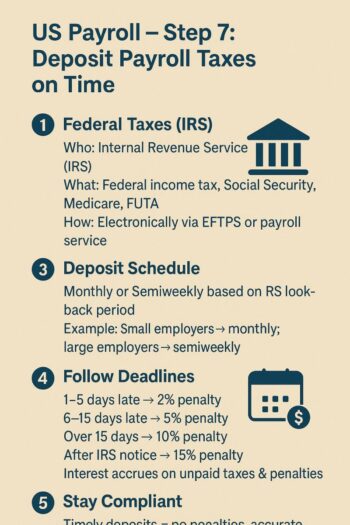
πŸ’Ό US Payroll – Step 8: Deposit Payroll Taxes on Time (to Federal Taxes (IRS) / State Taxes (State Agencies) πŸ’ΌUS Payroll – Payroll Tax Deposits :- 1️⃣ Federal Taxes (IRS): *Who: Internal Revenue Service (IRS) *What: Federal income tax withholding, Social Security, Medicare, FUTA *How: Electronically via EFTPS (Electronic Federal Tax Payment System) or through payroll service 2️⃣ State Taxes (State Agencies): *Who: Your state’s Department of Revenue or equivalent *What: State income tax withholding, State Unemployment Tax (SUTA) *How: Via the state’s online portal or approved electronic system πŸ’‘ Tip: Always check state-specific rules β€” each state has its own deposit schedule and payment methods 1️⃣ Know Your Deposit Schedule – Decide if you’re a monthly or semi-weekly depositor (based on your IRS lookback period). πŸ‘‰ Example: Small employers usually deposit monthly; large ones, semi-weekly. 2️⃣ Deposit Electronically – Use EFTPS (Electronic Federal Tax Payment System) or your payroll software to make payments securely. 3️⃣ Follow Strict Deadlines – IRS penalties apply for late deposits: 1) 1–5 days late β†’ 2% penalty 2) 6–15 days late β†’ 5% penalty 3) Over 15 days late β†’ 10% penalty After IRS notice β†’ 15% penalty πŸ’‘ Interest accrues on both unpaid tax and penalties until fully paid. 4️⃣ Stay Compliant – Timely deposits = no penalties, no stress, and clean payroll records!
US Payroll – Step 7: Deposit Payroll Taxes on Time (to Federal Taxes (IRS) / State Taxes (State Agencies) Read More Β»

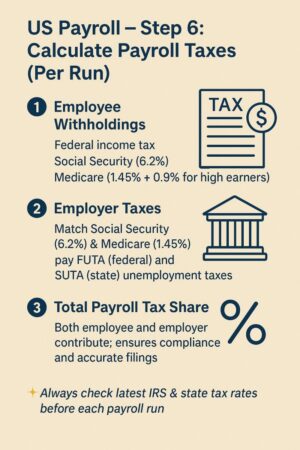
US Payroll – Step 6: Calculate Payroll Taxes (Per Run)

πŸ’Ό US Payroll – Step 6: Calculate Payroll Taxes (Per Run) 🧾 What It Means:- Payroll taxes are shared between employees and employers β€” covering federal income tax, Social Security, Medicare, and unemployment taxes. Example – just like in India where PF (Provident Fund) has both portions (employees and employers). The only difference in the US, this deduction is for taxes (Social Security & Medicare) instead of PF. Note: Federal income tax, Social Security, Medicare, and unemployment taxes are not retirement funds β€” they are taxes. (The PF example is only for easy understanding of how both employee and employer contribute.) 1️⃣ Employee Withholdings (deducted from employee pay) *Federal Income Tax – Based on W-4 form selections. *Social Security – 6.2% (up to annual wage limit). *Medicare – 1.45% (+0.9% extra for high earners). πŸ‘‰ Example: $1,000 pay β†’ $62 Social Security + $14.50 Medicare withheld. 2️⃣ Employer Taxes (paid by the employer) *Social Security (6.2%) + Medicare (1.45%) – Employer matches these amounts. *FUTA (Federal Unemployment Tax) – Employer only; report on Form 940. *SUTA (State Unemployment Tax) – Rate varies by state. πŸ‘‰ Example: Employer pays same 7.65% + unemployment taxes. ✨ Pro Tip: Always check the latest IRS and state tax rates before processing payroll β€” they change annually!

US Payroll – Step 6: Calculate Payroll Taxes (Per Run) Read More Β»

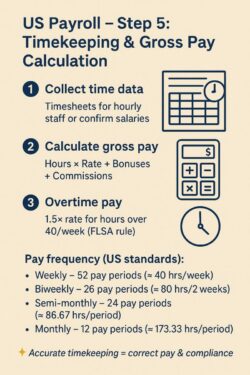
US Payroll – Step 5: Timekeeping & Gross Pay Calculation

πŸ’ΌUS Payroll – Step 5: Timekeeping & Gross Pay Calculation: – 1️⃣ Collect Time Data – Get timesheets/timecards for hourly staff or confirm salaries. πŸ‘‰ Example: Hourly employee logs 45 hours; salaried employee gets fixed pay. 2️⃣ Calculate Gross Pay – Hours Γ— Rate + Bonuses + Commissions + Taxable Reimbursements. πŸ‘‰ Example: 40 hrs Γ— $20 = $800 + $50 bonus = $850 gross pay. 3️⃣ Overtime Pay – 1.5Γ— regular rate for hours over 40/week (per FLSA). πŸ‘‰ Example: 5 overtime hrs Γ— $30 = $150 extra. 4️⃣ Pay Frequency (as per US payroll standards):- 1) Weekly: 52 pay periods per year (β‰ˆ 40 hrs/week) 2) Biweekly: 26 pay periods per year (β‰ˆ 80 hrs every 2 weeks) 3) Semi-monthly: 24 pay periods per year (β‰ˆ 86.67 hrs per period) 4) Monthly: 12 pay periods per year (β‰ˆ 173.33 hrs per period) ✨ Accurate timekeeping ensures correct pay, overtime, and tax calculations!

US Payroll – Step 5: Timekeeping & Gross Pay Calculation Read More Β»

US Payroll – Step 4: Set Up Benefits & Deductions

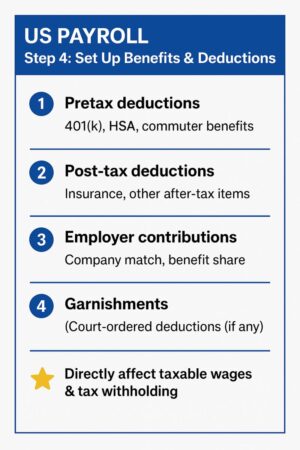
πŸ’ΌUS Payroll – Step 4: Set Up Benefits & Deductions :- 1️⃣ Pre-tax deductions – 401(k), HSA, commuter benefits πŸ‘‰ Example: Employee puts $200/month into 401(k) before taxes. 2️⃣ Post-tax deductions – Insurance, other after-tax items πŸ‘‰ Example: $50/month for optional life insurance. 3️⃣ Employer contributions – Company match, benefit share πŸ‘‰ Example: Employer matches 3% in 401(k). 4️⃣ Garnishments – Court-ordered deductions (if any) πŸ‘‰ Example: Child support payment withheld. πŸ‘‰ These payroll posts are not just for HR or Payroll preparer β€” they help you understand taxes too. Payroll connects directly to W-2 and when filing Form 1040, the figures come from W-2. So don’t ignore β€” payroll and tax returns go hand in hand!  

US Payroll – Step 4: Set Up Benefits & Deductions Read More Β»

US Payroll – Step 3: Choose Pay Frequency & Payroll System

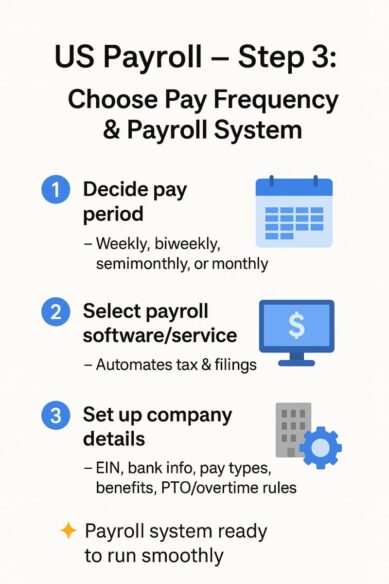
πŸ’ΌUS Payroll – Step 3: Choose Pay Frequency & Payroll System :- 1️⃣ Decide Pay Period – Weekly, biweekly, semi-monthly, or monthly πŸ‘‰ Example: Most US companies pay biweekly (every 2 weeks). 2️⃣ Select Payroll Software/Service – Automates tax calculations, deposits & filings πŸ‘‰ Example: Gusto, ADP, QuickBooks Payroll. 3️⃣ Set Up Company Details – EIN, bank info, pay types, benefits, PTO/overtime rules πŸ‘‰ Example: Add direct deposit details + 401(k) deduction rules. ✨ Once setup your payroll system is ready to run smoothly.

US Payroll – Step 3: Choose Pay Frequency & Payroll System Read More Β»

US Payroll – Step 2: Collect Employee Documents

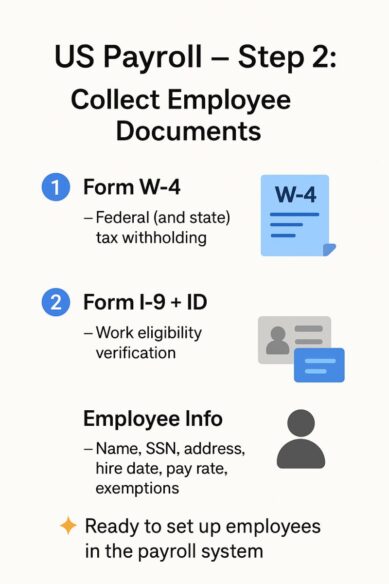
πŸ’ΌUS Payroll – Step 2: Collect Employee Documents :- 1️⃣ Form W-4 – Federal tax withholding Confirmation from Employee, (plus state forms if required). πŸ‘‰ Example: This tells you how much tax to deduct from paychecks. 2️⃣ Form I-9 + ID – To verify work eligibility in the US. πŸ‘‰ Example: Passport, or Driver’s License + Social Security Card. 3️⃣ Employee Info – Name, SSN, address, hire date, pay rate, exemptions. ✨ With these basics information you can now set up employees in your payroll system.  

US Payroll – Step 2: Collect Employee Documents Read More Β»

US Payroll – Step 1: Get Set Up

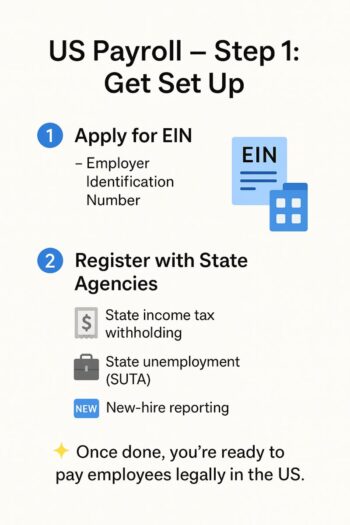
πŸ’ΌUS Payroll – Step 1: Get Set Up :- 1️⃣ Apply for EIN (Employer Identification Number) :- Think of this like your company’s “Tax ID number” from the IRS. πŸ‘‰ Example: Just like you need a NTN in Pakistan, your business needs an EIN in the US. 2️⃣ Register with State Agencies: – -For state income tax withholding 🧾 -For state unemployment (SUTA) πŸ’Ό -For new-hire reporting πŸ†• (each state has its own deadline, usually within 20 days). ✨ Once these are in place, you’re officially ready to pay employees legally in the US.  

US Payroll – Step 1: Get Set Up Read More Β»

Form 8938 (FATCA) – Specified Foreign Financial Assets

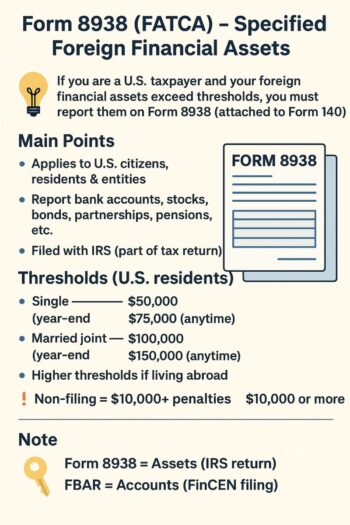
πŸ’‘ Form 8938 (FATCA) – Specified Foreign Financial Assets :- If you are a U.S. taxpayer and your foreign financial assets exceed certain thresholds, you must report them on Form 8938 (attached to your Form 1040). πŸ“Œ Main Points :- β€’ Applies to U.S. citizens, residents & certain entities. β€’ Report bank accounts, stocks, bonds, foreign partnerships, pensions, life insurance with cash value, etc. β€’ File with IRS (part of your income tax return). β€’ Thresholds (U.S. residents): – Single: > $50,000 (year-end) / $75,000 (anytime) – Married Filing Jointly: > $100,000 (year-end) / $150,000 (anytime) β€’ Higher thresholds apply if living abroad. β€’ Non-filing = $10,000+ penalties (can increase if not corrected). βœ… Example: Foreign Bank A = $40,000 Foreign Stocks = $90,000 πŸ‘‰ Total = $130,000 β†’ Single filer β†’ Form 8938 required. ✨ Easy-to-remember points: *FBAR β‰  Form 8938 β†’ Both may apply. *Form 8938 is about assets (attached to IRS return). *FBAR is about accounts (filed separately with FinCEN). πŸ”‘ Remember: Form 8938 = IRS tax compliance under FATCA, aimed at transparency of offshore wealth.

Form 8938 (FATCA) – Specified Foreign Financial Assets Read More Β»

FBAR vs Form 8938 – What’s the Difference?

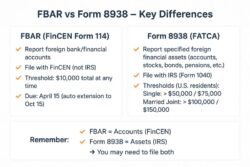
FBAR vs Form 8938 – What’s the Difference? πŸ“Œ FBAR (FinCEN Form 114):- β€’ Report foreign bank/financial accounts. β€’ File online with FinCEN (not IRS). β€’ Threshold: $10,000 total at any time in the year. β€’ Due: April 15 (auto extension to Oct 15). πŸ“Œ Form 8938 (FATCA):- β€’ Report specified foreign financial assets (bank accounts, stocks, bonds, partnerships, pensions, etc.). β€’ File with IRS (attached to Form 1040). β€’ Thresholds: – Single: > $50,000 (year-end) / $75,000 (anytime) – Married Joint: > $100,000 (year-end) / $150,000 (anytime). βœ… Example: Foreign Bank = $40,000 Foreign Stocks = $90,000 πŸ‘‰ Total = $130,000 (Single filer) βœ” FBAR required (accounts > $10k) βœ” Form 8938 required (assets > $75k) πŸ”‘ Remember:- *FBAR = Accounts (FinCEN) *Form 8938 = Assets (IRS) ➑ Sometimes you must file both.

FBAR vs Form 8938 – What’s the Difference? Read More Β»

Itemized Deductions vs Tax Credits – What’s the Difference?

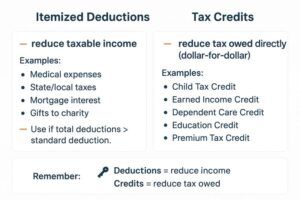
πŸ’‘ Itemized Deductions vs Tax Credits – What’s the Difference? πŸ“Œ Itemized Deductions β†’ reduce your taxable income:- Examples: β€’ Medical expenses β€’ State & local taxes β€’ Mortgage interest β€’ Gifts to charity πŸ‘‰ If your deductions are higher than the standard deduction then you select itemize. πŸ“Œ Tax Credits β†’ reduce your tax liability directly (dollar-for-dollar) :- Examples: β€’ Child Tax Credit β€’ Earned Income Credit β€’ Dependent Care Credit β€’ Education Credit β€’ Premium Tax Credit (health insurance) βœ… Example: *Taxable income = $60,000 *Itemized deductions = $15,000 β†’ lowers taxable income to $45,000 *Tax = $5,000 β†’ apply Child Tax Credit $2,000 β†’ final tax = $3,000 πŸ”‘ Remember: *Deductions reduce income before tax is calculated. *Credits reduce tax owed after calculation.  

Itemized Deductions vs Tax Credits – What’s the Difference? Read More Β»